
2026-03-20
If you have any needs regarding SF6 gas recovery, purification, and recycling, please feel free to contact us using the information below! We offer high-quality, standardized SF6 gas processing equipment that ensures the purity of recycled SF6 gas and helps you save on the cost of purchasing new gas.
| Phone Number: | +86-0371-68988008 |
|---|---|
| Email: | [email protected] |
| Address: | High-new Tech Zone Zhengzhou, Henan, China |
As the global energy sector pivots toward a greener grid, the management of Sulfur Hexafluoride (SF6) has moved from a routine maintenance task to a high-stakes environmental mandate. With the 2026 F-gas regulations now in full effect across the EU and North America, power utilities are no longer just looking for equipment; they are seeking a comprehensive “Circular Economy” solution.
The implementation of closed-loop SF6 gas recovery for substations is the only viable path to balancing operational reliability with strict carbon-neutrality targets. This article explores the technical architecture, regulatory necessity, and performance benchmarks of modern SF6 recovery units designed to meet the demands of 72.5kV to 500kV infrastructure.
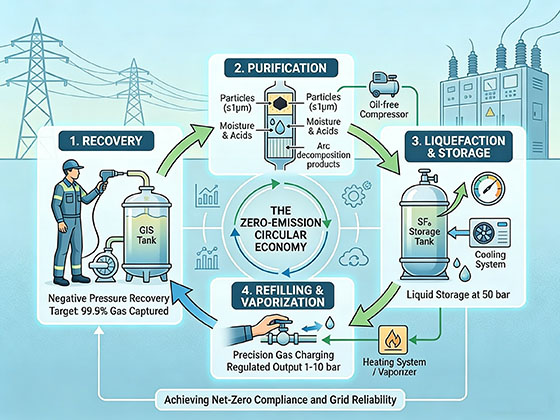
A true “closed-loop” process ensures that SF6 gas never enters the atmosphere. It treats the gas as a valuable asset that is extracted, purified, and re-injected in a continuous cycle.
Modern SF6 recovery units designed for this purpose are no longer simple pumps. They are integrated processing centers that combine several critical functions:
High-Depth Vacuuming: Evacuating air and moisture from the Gas Insulated Switchgear (GIS).
Negative Pressure Recovery: Ensuring every gram of gas is captured, even when equipment pressure drops below atmospheric levels.
Multi-Stage Purification: Removing the toxic byproducts that form during electrical arcing.
Precision Refilling: Utilizing vaporizers and regulated outputs to return gas at exact nameplate pressures.
A primary challenge in closed-loop SF6 gas recovery for substations is the degradation of the gas molecule. During circuit breaker operations, high-temperature arcing breaks down SF6 into toxic byproducts like SO2, HF, and various metal fluorides.
To achieve a successful closed-loop, the SF6 recovery unit must feature an industrial-grade filtration system:
Particle Retention: High-precision filters must capture solid decomposition products with a filtration diameter of less than or equal to 1 micrometer. This prevents abrasive “white powder” from damaging internal seals.
Chemical Neutralization: Integrated molecular sieves and activated alumina beds strip moisture and acidic gases.
Oil-Free Compression: To prevent secondary contamination, the system must utilize oil-free, water-cooled compressors (typically rated at 15 cubic meters per hour). This ensures that the gas remains free of hydrocarbon vapors, allowing for immediate reuse according to IEC 60480 standards.
For procurement and engineering teams, the 2026 market demands specific performance parameters. A top-tier recovery unit, such as those meeting DL/T 662 standards, should adhere to the following specifications:
| Parameter | 2026 Industry Standard | Operational Impact |
| Recovery Rate | Greater than 99.9% (Negative Pressure) | Prevents residual emissions during maintenance. |
| Output Pressure | 50 bar | Facilitates high-density liquid storage in cylinders. |
| Vaporizer Power | 1.5 kW | Prevents “freezing” during high-speed refilling. |
| Vacuum Display | Real-time PLC Monitoring | Allows for precise leak detection and audit trails. |
| Refilling Speed | 50kg in 5 to 8 minutes | Drastically reduces substation downtime. |
The move toward liquid filling capabilities is a significant trend for 2026. High-pressure liquid transfer allows for the efficient storage of large gas volumes in compact cylinders, a necessity for the large-scale GIS bays found in 220kV and 500kV substations.
The complexity of substation maintenance requires equipment that minimizes human error. Modern recovery carts utilize a modular, semi-enclosed structure controlled by a PLC operation screen.
During the recovery phase, the PLC provides instant feedback on vacuum levels, allowing technicians to verify the integrity of the seals before proceeding. When it comes to refilling, the system offers multiple modes—Direct Fill, Pressure Regulated Fill, and Liquid Charging—allowing the operator to tailor the process to the specific requirements of the equipment, whether it is a small 72.5kV breaker or a massive 500kV porcelain column circuit breaker.
A major pain point in closed-loop SF6 gas recovery for substations is the impact of ambient temperature. In hot climates, gas liquefaction becomes difficult, while in cold climates, refilling speeds drop due to adiabatic cooling.
The latest recovery units solve this through customizable refrigeration and heating systems:
Auxiliary Cooling: Water-cooled or high-efficiency air-cooled systems ensure rapid recovery even in 40°C+ environments.
Integrated Heating: A dedicated gas heating system ensures that during refilling, the SF6 stays in a gaseous state as it expands, maintaining a steady flow of 1 to 10 bar without the risk of equipment freezing.
Beyond environmental compliance, there is a clear financial incentive for adopting a closed-loop strategy.
Asset Protection: By removing moisture and HF acid, the recovery unit extends the life of the switchgear, preventing internal corrosion.
Resource Efficiency: Recovered and purified SF6 is significantly cheaper than purchasing virgin gas, which has seen price surges due to production quotas.
Risk Mitigation: Automated safety features, such as anti-return oil valves on vacuum pumps, prevent catastrophic contamination of the GIS during power failures.
From a search optimization perspective, “closed-loop SF6 gas recovery for substations” captures high-intent traffic from utility managers focusing on E-E-A-T (Experience, Expertise, Authoritativeness, and Trustworthiness). Google’s 2026 ranking algorithms prioritize content that links technical parameters (like the 50 bar final pressure) with real-world applications (like 500kV maintenance).
By providing a rigorous analysis of how these units function within the larger power grid, this content establishes your brand as a technical authority in the field of industrial gas handling.
As we move through 2026, the era of “vent-and-fill” is officially over. Closed-loop SF6 gas recovery for substations represents the pinnacle of modern grid maintenance. By investing in units that offer sub-micron filtration, oil-free compression, and real-time PLC monitoring, power utilities can ensure their operations remain compliant, cost-effective, and environmentally responsible.