
2026-03-13
If you have any needs regarding SF6 gas recovery, purification, and recycling, please feel free to contact us using the information below! We offer high-quality, standardized SF6 gas processing equipment that ensures the purity of recycled SF6 gas and helps you save on the cost of purchasing new gas.
| Phone Number: | +86-0371-68988008 |
|---|---|
| Email: | [email protected] |
| Address: | High-new Tech Zone Zhengzhou, Henan, China |
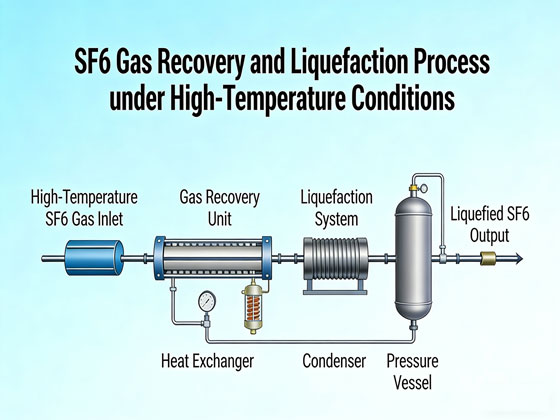
In high-ambient temperature environments—such as those found in the Middle East or tropical regions—liquidizing SF6 gas presents a significant thermodynamic challenge. Because SF6 has a relatively low critical temperature of approximately 45.5°C, the recovery unit must employ specific engineering strategies to ensure the gas transitions from a gaseous state to a stable liquid for storage.
A professional SF6 recovery unit handles this through a combination of high-pressure compression and dedicated refrigeration modules.
The first step in liquefaction is increasing the gas density. The SF6 recovery unit uses a high-performance, water-cooled, oil-free compressor to raise the pressure of the SF6 gas. In high-ambient conditions, the compressor must work harder to reach the liquefaction threshold.
Compression Target: To liquefy gas at temperatures near 40°C, the compressor often needs to reach pressures exceeding 3.5 MPa to 5.0 MPa.
Water Cooling: By using a water-cooled jacket around the compressor head, the SF6 recovery unit removes the heat of compression more efficiently than air-cooled models, preventing the gas from remaining in a superheated state.
When the ambient temperature approaches or exceeds the critical temperature of SF6 (45.5°C), compression alone is insufficient because the gas will not liquefy regardless of the pressure.
Active Cooling: High-end SF6 recovery units are equipped with an integrated refrigeration system. This “chiller” cools the high-pressure gas below the ambient temperature before it enters the storage tank.
Heat Exchangers: The compressed gas passes through a high-efficiency condenser where the refrigerant absorbs the thermal energy, dropping the gas temperature to a range (typically 10°C to 20°C) where liquefaction is easily achieved at moderate pressures.
Once the gas is liquefied, it must be kept stable inside the storage tank.
Liquid Level Monitoring: Units use load cells or ultrasonic sensors to monitor the weight of the liquid SF6.
Buffer Volume: Operators must ensure the tank is not overfilled (usually an 80% limit) to allow for thermal expansion. If the ambient temperature causes the tank pressure to rise too high, the unit’s automated PLC will trigger a “re-circulation” mode, where the gas is pulled out, re-cooled by the chiller, and sent back into the tank to lower the overall internal energy.
Interestingly, high-ambient temperatures actually help the reverse process. When refilling a GIS from the unit, the liquid SF6 must vaporize. Rapid vaporization causes a massive drop in temperature (Joule-Thomson effect), which can freeze valves. In these scenarios, the unit’s 1.5 kW vaporizer ensures the gas stays above freezing during high-speed discharge, even if the external air is hot.
| Component | Role in High-Heat Liquefaction |
| Water-Cooled Compressor | Provides high-density compression without overheating the gas. |
| Refrigeration Module | Drops gas temperature below the critical point (45.5°C). |
| PLC Control | Monitors the pressure-temperature curve to prevent gas from staying in a gaseous state. |
| Semi-Enclosed Chassis | Protects internal cooling fans and compressors from direct solar radiation. |