
2026-03-04
If you have any needs regarding SF6 gas recovery, purification, and recycling, please feel free to contact us using the information below! We offer high-quality, standardized SF6 gas processing equipment that ensures the purity of recycled SF6 gas and helps you save on the cost of purchasing new gas.
| Phone Number: | +86-0371-68988008 |
|---|---|
| Email: | [email protected] |
| Address: | High-new Tech Zone Zhengzhou, Henan, China |
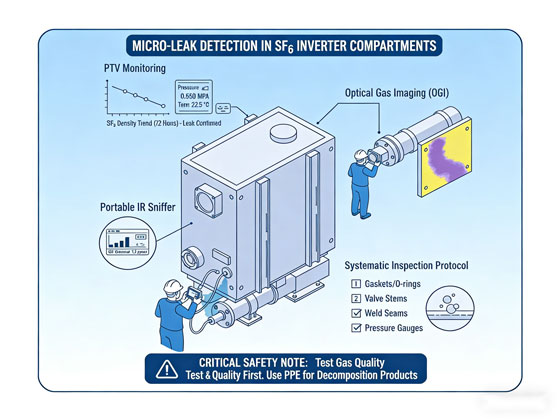
Detecting micro-leaks in sealed SF6 compartments requires a systematic approach that moves from macro-level density monitoring to micro-level point detection. Because SF6 is a potent greenhouse gas, regulations often demand high sensitivity—frequently requiring the detection of leaks as small as 1 gram per year or less.
Here is a professional, rigorous approach to locating these elusive leaks.
Before you start hunting for a specific leak point, you must confirm that a leak actually exists. Pressure drop is not always synonymous with a leak; it is often a result of temperature fluctuation (the Ideal Gas Law in practice).
Temperature Compensation: Because SF6 density is highly dependent on temperature, you must record both internal pressure and gas temperature simultaneously.
The PTV (Pressure-Temperature-Volume) Method: Calculate the “Standard Pressure” at a reference temperature (usually 20°C). If the calculated density has consistently declined over a specific period (e.g., 24 to 72 hours), you have confirmed a leak.
Once a leak is confirmed, you need to identify the exact location. Portable “sniffers” are the industry standard for this task.
Infrared (IR) Absorption: These are highly effective and less prone to “false positives” from other gases. They work by detecting the specific infrared absorption spectrum of SF6.
Electron Capture (ECD): These are incredibly sensitive (some can detect leaks down to 0.1 grams per year) but can be easily “saturated” if the room has high background concentrations of SF6.
Field Strategy: * Work from the bottom up: SF6 is heavier than air; leaks will often accumulate in low-lying areas, pockets, or corners near the floor.
Account for airflow: Even minor drafts can dilute the gas, making a micro-leak undetectable. Seal doors and turn off ventilation systems during the inspection.
For large compartments with complex flange arrangements, manually sniffing every joint can be time-consuming. OGI cameras use specialized spectral filters to “visualize” SF6 gas as smoke on a screen.
Efficiency: This is the fastest way to screen large surface areas, such as long bus-ducts or large transformer tanks.
Limitation: While excellent at finding “major” leaks quickly, standard OGI cameras may struggle to pinpoint ultra-micro SF6 leaks without the aid of a secondary handheld sniffer.
If the sniffers and imaging don’t reveal the leak, the fault is likely in a flange, gasket, or valve that is not easily accessible. Follow this hierarchy of inspection:
Gaskets and O-rings: These are the most common failure points due to thermal cycling, which causes the seal to “set” or harden over time.
Valve Stems and Caps: Often overlooked. Ensure valve caps are tight and contain a secondary sealing washer.
Weld Seams: Rare, but can develop porosity leaks. These often require the “soapy water” method (using a high-sensitivity SF6 leak-detecting bubble solution) as a last resort if the electronic sniffer is inconclusive.
Pressure Gauges/Density Relays: The junction where the gauge meets the compartment is a frequent point of micro-leakage due to vibrations.
| Method | Best Use Case | Sensitivity |
| PTV Monitoring | Initial confirmation of leak | Low (Trend based) |
| Portable IR Sniffer | Pinpointing specific valves/flanges | High |
| Electron Capture | Laboratory/Controlled environment | Extremely High |
| Optical Gas Imaging | Large area scanning | Moderate |
When working with SF6, always be aware of decomposition products. If the compartment has experienced internal arcing, the gas inside may contain toxic byproducts like sulfur dioxide or hydrogen fluoride. Never open a compartment without first testing the SF6 gas quality. If you suspect an internal fault, use personal protective equipment (PPE), including gas masks and acid-resistant gloves, even if you are only checking for external leaks.