
2026-03-25
If you have any needs regarding SF6 gas recovery, purification, and recycling, please feel free to contact us using the information below! We offer high-quality, standardized SF6 gas processing equipment that ensures the purity of recycled SF6 gas and helps you save on the cost of purchasing new gas.
| Phone Number: | +86-0371-68988008 |
|---|---|
| Email: | [email protected] |
| Address: | High-new Tech Zone Zhengzhou, Henan, China |
In the landscape of modern power transmission, Ultra-High Voltage (UHV) substations serve as the “beating heart” of national energy security. As global power grids shift toward higher voltages and greater capacities to accommodate renewable energy integration, the reliability of gas-insulated switchgear (GIS) becomes paramount. Central to this reliability is Sulfur Hexafluoride (SF6) gas.
However, maintaining SF6 is no longer just about insulation performance; it is about environmental stewardship and precise chemical diagnostics. This is where the SF6 gas comprehensive tester for UHV substation maintenance emerges as an indispensable tool for electrical engineers and asset managers.
UHV substations operate under extreme electrical stress. SF6 gas is utilized for its superior dielectric strength and arc-quenching capabilities. Yet, over time, high-energy partial discharges or thermal faults can cause the gas to decompose into toxic and corrosive byproducts.
If left undetected, these decomposition products can damage internal components, leading to catastrophic equipment failure. A high-performance SF6 gas comprehensive tester for UHV substation maintenance provides the “blood test” necessary to diagnose the internal health of these massive machines without taking them offline.
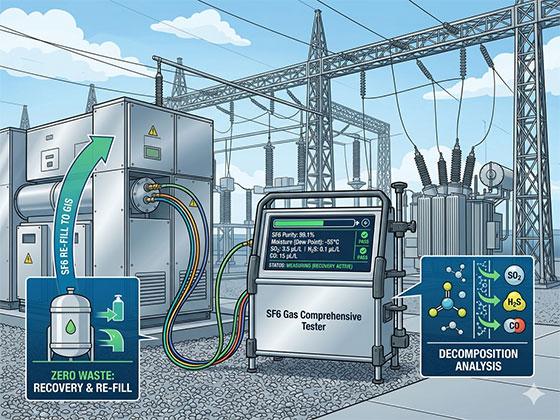
Traditional maintenance required multiple bulky instruments—one for humidity, one for purity, and another for decomposition products. The modern comprehensive tester revolutionizes this workflow by integrating five key metrics into a single, portable unit:
Purity Analysis: Ensuring the SF6 concentration remains above critical thresholds (typically >98%).
Moisture (Dew Point) Detection: Preventing water vapor from condensing and causing flashovers.
Decomposition Product Monitoring: Measuring SO2, H2S, and CO to identify arcing or overheating.
A standout feature of the premium SF6 gas comprehensive tester for UHV substation maintenance is its internal recovery and back-filling system. Because SF6 is a potent greenhouse gas, venting even small amounts during testing is unacceptable. This device allows the sampled gas to be pumped back into the equipment or an external storage vessel, achieving zero emissions.
To understand why this instrument is the gold standard for UHV maintenance, we must look at the precision of its sensor array.
| Parameter | Measurement Principle | Range | Accuracy |
| SF6 Purity | Thermal Conductivity | 0 to 100% | +/- 0.5% |
| Moisture (Humidity) | Laser / Resistance-Capacitance | -60°C to +20°C | +/- 1°C to +/- 2°C |
| Sulfur Dioxide (SO2) | Electrochemical | 0 to 100 microliters/L | +/- 0.5 microliters/L (low range) |
| Hydrogen Sulfide (H2S) | Electrochemical | 0 to 100 microliters/L | +/- 0.5 microliters/L (low range) |
| Carbon Monoxide (CO) | Electrochemical | 0 to 500 microliters/L | +/- 2 microliters/L (low range) |
For UHV applications, humidity measurement is often the most sensitive variable. The option for Laser-based moisture detection offers rapid response times (less than or equal to 30s) and high resistance to sensor “drifting,” ensuring that even in the high-pressure environment of a UHV circuit breaker, the data remains rock-solid.
Modern maintenance is no longer just about taking a reading; it is about interpreting data. The SF6 gas comprehensive tester for UHV substation maintenance features a built-in Expert Diagnosis System.
Instead of manual look-up tables, the system automatically compares measured values against international standards (like IEC 60480 or GB/T 12022). If SO2 levels exceed 10 microliters/L, the system immediately flags the equipment for inspection, suggesting a possible internal discharge.
With a storage capacity of up to 10,000 records and USB export functionality, this tester integrates seamlessly into a substation’s Digital Twin or CMMS (Computerized Maintenance Management System). This allows for trend analysis: if moisture levels are rising by 2% annually, maintenance teams can schedule a regassing before a critical threshold is reached.
UHV substations are vast, often spanning several acres with uneven terrain. The physical design of the tester is just as important as its internal sensors:
Pull-rod Box Design: Equipped with rugged wheels and a telescopic handle, the unit can be moved across gravel or cable trenches easily.
Modular Architecture: The “Unique Design” mentioned in the specs allows for individual modules (like the H2S sensor) to be replaced or calibrated without dismantling the entire machine, drastically reducing downtime.
One-Key Automation: Once connected, a single button press initiates the purging, measuring, and data-locking sequence, minimizing human error.
The implementation of a SF6 gas comprehensive tester for UHV substation maintenance provides a dual benefit:
The global warming potential (GWP) of SF6 is approximately 23,500 times that of CO2. By utilizing the recycling and back-filling function, utilities can demonstrate a commitment to “Green Grid” initiatives. The tester ensures that every gram of gas sampled is returned to the system, avoiding carbon taxes and environmental fines.
Preventive maintenance is significantly cheaper than reactive repairs. A UHV transformer or GIS failure can cost millions in hardware and lost revenue. By detecting trace amounts of H2S or SO2 early, utilities can perform targeted maintenance, extending the life of assets by decades.
To get the most out of your comprehensive tester, maintenance teams should follow a standardized protocol:
Pre-test Purge: Ensure the sampling hose is cleared of ambient air to prevent moisture contamination.
Flow Control: Maintain the default 150 mL/min flow rate to ensure the electrochemical sensors have sufficient time to react without being “overwhelmed” by high-pressure gas.
Pressure Monitoring: Ensure the input pressure stays within the 0.4 to 2 MPa range to protect the internal manifold.
The SF6 gas comprehensive tester for UHV substation maintenance is more than just a measuring device; it is a critical safeguard for the modern electrical age. Its ability to provide laboratory-grade precision in a field-ready package—combined with its “zero-emission” recycling capabilities—makes it the definitive choice for forward-thinking utility providers.
As we move toward a smarter, more resilient grid, the data provided by these instruments will be the foundation of predictive maintenance strategies. Investing in high-quality SF6 analysis is not just an operational choice; it is an investment in the stability of the entire power network.