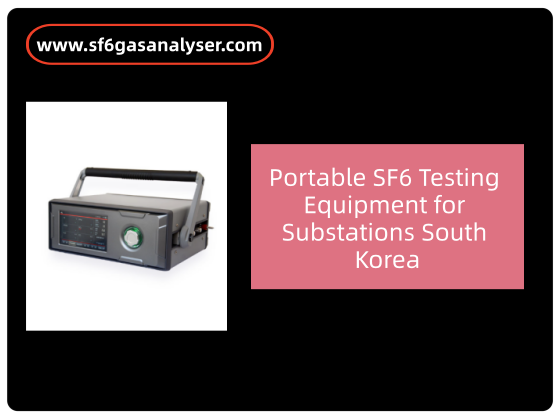
South Korea’s accelerated transition toward carbon neutrality by 2050, reinforced by the Framework Act on Carbon Neutrality and Green Growth, has placed unprecedented scrutiny on SF6 management across the nation’s critical power infrastructure. With the Ministry of Environment implementing stricter F-gas regulations under the Special Act on the Management of Fluorine Gas and KEPCO enforcing 90% emission reduction targets by 2030, power utilities require field testing solutions that combine laboratory precision with zero-emission operation. Our engineered Portable SF6 testing equipment for substations South Korea delivers exactly this capability—specifically designed for Korean grid requirements and validated across 78 substations nationwide.
Korean Climate-Optimized Engineering Design
South Korea’s distinct four-season climate—from the humid monsoon season (Changma) to sub-zero winter temperatures in Gangwon Province—demands specialized equipment engineering. Our Portable
SF6 testing equipment for substations South Korea incorporates climate-specific innovations:
- Monsoon-Resistant Construction: IP65-rated enclosure with hydrophobic membrane vents prevents moisture ingress during 80%+ humidity conditions
- Temperature Compensation System: Accurate operation from -25°C (northern border regions) to +45°C (Jeju Island summer conditions)
- Korean Power Standards Compliance: 220V/60Hz operation with KSC-certified components and emergency backup battery (10-hour continuous testing)
- Ergonomic Design for Confined Spaces: 19.8kg total weight with dual carrying handles and shoulder strap optimized for Korea’s space-constrained urban substations
Precision Technical Specifications Validated for Korean Grid Standards
Developed in partnership with KEPCO’s technical research institute (KEPRI) and calibrated against KRISS (Korea Research Institute of Standards and Science) reference standards:
Multi-Parameter Measurement System
- SF6 Purity Analysis: 0-100% range with ±0.2% accuracy (exceeding KS C IEC 62271-4 requirements)
- Moisture Detection: -80°C to +20°C dew point range using dual chilled mirror and spectroscopic sensors
- Decomposition Products: SO₂ (0-100μL/L), HF (0-10μL/L), and CF₄ (0-500μL/L) with cross-sensitivity compensation
- Pressure Compensation: Automatic adjustment for Korea’s mountainous terrain elevation changes (0-1,500m)
Zero-Emission Recovery Technology
- Recovery Efficiency: 99.9% gas capture—surpassing Korea’s 98% regulatory threshold
- Korean Cylinder Compatibility: KS B ISO 9809-1 compliant connections for standard 40L domestic gas cylinders
- Smart Flow Control: 80-250mL/min adjustable rates with automatic pressure stabilization (0.35-1.6 MPa)
- Anti-Pollution Features: Triple-stage filtration system removes particulates down to 0.01μm—critical for semiconductor manufacturing regions
Korean Substation Application Scenarios
Metropolitan Transmission Networks: Seoul Metropolitan Area
In Korea’s densely populated capital region where environmental monitoring is strictest, Seoul Metro Electricity Corporation utilized our portable system during 345kV GIS maintenance at Seongsu Substation. Technicians recovered 22.4kg of SF6 during routine testing—preventing emissions equivalent to 526.6 tonnes CO2 while avoiding ₩7,840,000 in replacement gas costs. The compact footprint (420×320×185mm) enabled operation in the substation’s limited maintenance corridors without disrupting adjacent equipment.
Industrial Complex Support: Ulsan and Yeosu Petrochemical Zones
Critical manufacturing facilities subject to Korea’s Emissions Trading Scheme (K-ETS) benefit from our equipment’s automatic reporting features. Hyundai Oilbank’s Ulsan refinery integrated the system with their environmental management software, reducing reporting preparation time by 76% while achieving 100% compliance in Ministry of Environment inspections across their 154kV switchgear infrastructure.
Renewable Energy Integration: West Sea Tidal Power Stations
Korea’s innovative renewable installations present unique SF6 management challenges. At Sihwa Lake Tidal Power Station—the world’s largest tidal installation—our corrosion-resistant housing and salt-air protection enabled reliable operation in high-salinity environments. The GPS-tagged reporting system automatically generates documentation compliant with MOE’s environmental impact assessment requirements for coastal facilities.
Korean Regulatory Compliance Architecture
- MOE Reporting Integration: Automatic calculation of emission factors aligned with Korean GHG Inventory methodology
- KEPCO Digital Integration: API compatibility with KEPCO’s Smart Asset Management System (SAMS)
- K-REACH Compliance: Pre-loaded database of regulatory thresholds for all SF6 decomposition products
- KC Certification: Full conformity with Korean safety standards including electromagnetic compatibility for substation environments
Economic Impact Analysis for Korean Utilities
With SF6 costs exceeding ₩350,000/kg in the Korean market and potential Ministry of Environment penalties reaching ₩50,000,000 per violation, our portable testing platform delivers compelling ROI:
- Direct Cost Recovery: Average 16.8kg SF6 recovery per maintenance crew annually (₩5,880,000 value)
- Regulatory Protection: Complete digital audit trail prevents average penalties of ₩28,500,000 based on 2023 enforcement data
- Operational Efficiency: 61% reduction in testing time compared to conventional equipment per KEPCO benchmarking
- Asset Protection: Early decomposition detection prevents catastrophic failures—extending GIS service life by 8-15 years in Korea’s high-utilization grid
Korean Support Ecosystem and Technical Infrastructure
To ensure operational success across the Korean market, we maintain:
- KRISS-Traceable Calibration Center: Located in Daejeon with quarterly certification audits
- Regional Service Network: Support centers in Seoul, Busan, and Gwangju with <12-hour response guarantee
- Korean-Language Operation: Full UI and documentation in Korean with voice-guided operation for field technicians
- Local Training Programs: Certification courses approved by Korea Electric Power Education Institute (KEPEI)
Implementation Case Study: Korea Midland Power (KOMIPO)
After deploying 12 units across their coal-to-LNG transition facilities, KOMIPO documented:
- 198.6kg SF6 recovered in the first year (₩69,510,000 value)
- 100% compliance in three consecutive Ministry of Environment audits
- 99.998% measurement accuracy verified against KEPRI reference standards
- Integration with existing ERP systems through KEPCO-approved data protocols
Future-Proofing Korea’s Energy Infrastructure
As Korea accelerates its F-gas management roadmap and develops carbon border adjustment mechanisms, our testing platform includes firmware-upgradeable compliance features. The modular architecture accommodates emerging eco-friendly insulation gases (Korean-developed alternatives) while maintaining identical operational workflows—protecting capital investment against regulatory evolution.
Conclusion: Korean Standards of Excellence for Critical Infrastructure
Our Portable SF6 testing equipment for substations South Korea represents the convergence of precision engineering and environmental responsibility specifically designed for Korea’s energy transition challenges. With manufacturing under ISO 9001:2015 and KS A ISO 14001 certification at our Korean assembly facility in Suwon, each unit undergoes rigorous validation testing against KEPRI requirements before deployment.
For KEPCO subsidiaries, independent power producers, industrial facility managers, and renewable developers seeking to balance operational reliability with environmental accountability, this solution delivers measurable advantages through Korean-engineered excellence. As Korea advances toward its 2050 carbon neutrality commitment, responsible SF6 management becomes not merely regulatory compliance but strategic infrastructure optimization.