
2026-06-17
If you have any needs regarding SF6 gas recovery, purification, and recycling, please feel free to contact us using the information below! We offer high-quality, standardized SF6 gas processing equipment that ensures the purity of recycled SF6 gas and helps you save on the cost of purchasing new gas.
| Phone Number: | +86-0371-68988008 |
|---|---|
| Email: | [email protected] |
| Address: | High-new Tech Zone Zhengzhou, Henan, China |
Finding the best portable gas analyzer price for power substation maintenance requires balancing upfront procurement budgets with high-precision field reliability. This comprehensive guide breaks down current market pricing tiers, essential technical specifications—including multi-gas SF6 and hydrogen monitoring—and core product advantages. Whether you are looking for an affordable spot-checking tool or a premium zero-emission gas recycling system to meet strict 2026 environmental compliance standards, understanding these cost factors helps electrical utilities and grid contractors maximize their return on investment. For personalized pricing structures or to request a detailed technical data sheet for your specific utility footprint, contact our engineering team directly at [email protected].
When electrical maintenance managers audit field testing equipment, evaluating the best portable gas analyzer price for power substation maintenance involves looking far beyond the initial sticker price. In high-voltage electrical environments, an unreliable instrument results in costly false positives, unnecessary grid downtime, and frequent laboratory cross-checks.
True field cost-efficiency comes from investing in rugged, suitcase-style platforms that integrate multiple diagnostic parameters into a single test cycle. By choosing a multi-functional device, utilities drastically reduce the total asset lifecycle cost, eliminate the need to purchase multiple single-gas meters, and ensure total compliance with local grid safety codes.
The final purchase cost of field equipment is heavily tied to sensor engineering, gas safety mechanisms, and measurement accuracy. If you are comparing quotes to find the best portable gas analyzer price for power substation maintenance, ensure the technical specifications include these baseline standards:
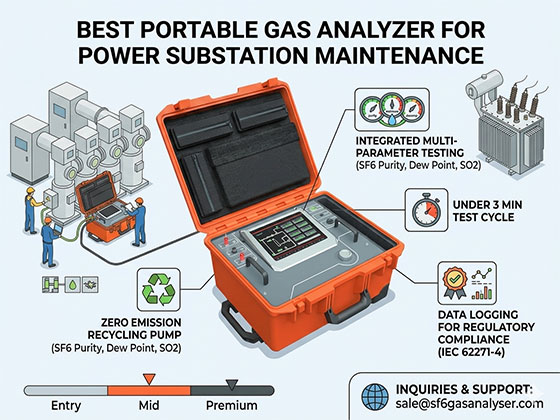
SF6 Purity Measurement: Utilizes non-dispersive infrared (NDIR) sensors providing an accuracy of plus or minus 0.5% or better across a 0–100% range.
Dew Point / Moisture Analysis: High-precision polymer or aluminum oxide sensors capable of measuring down to -60°C to +20°C to accurately track moisture content in insulating gas.
Decomposition Products (SO2 / HF): Electrochemical sensors tracking trace toxic degradation products down to 0–100 ppm to catch early internal arcing or insulation degradation.
Gas Recycling / Zero Emission Pump: An automated, oil-free micro-compressor and internal storage system that pumps sampled gas back into the GIS compartment or an external cylinder, preventing any environmental release.
Hydrogen Monitoring Support: Thermal conductivity (TCD) sensors for measuring H2 purity (90–100%) alongside trace moisture monitoring for hydrogen-cooled generator maintenance.
Investing in an optimized multi-gas field instrument yields concrete operational and financial returns for modern high-voltage grids:
Drastically Reduced Testing Time: Modern multi-parameter platforms finish a complete verification cycle (purity, moisture, and decomposition) in under 3 minutes per gas compartment, keeping substation maintenance schedules on track.
Regulatory and E-E-A-T Compliance: Built-in data logging with seamless USB or Bluetooth export features automatically formats maintenance records to satisfy strict ISO 14687 or IEC 62271-4 utility compliance audits.
Ruggedized Portability for Harsh Environments: Engineered inside shock-proof, IP67-rated hard cases with high-capacity lithium battery power designed to withstand harsh outdoor yard conditions.
To help procurement teams find the best portable gas analyzer price for power substation maintenance, the global market can be categorized into three distinct technical tiers:
| Equipment Tier | Approximate Price Range (USD) | Best Suited For | Core Features |
| Entry-Level / Single-Gas | $3,500 – $7,000 | Small industrial plants, basic gas leak tracking | Single parameter testing (e.g., just SF6 purity), manual gas venting, basic analogue interfaces. |
| Mid-Range / Multi-Gas Dual Function | $8,000 – $15,000 | Regional utility hubs, standard substation contractors | Combines purity and dew point analysis, standard data logging, requires external gas collection bags. |
| Premium / Fully Automated Zero-Emission | $18,000 – $35,000+ | Large power grids, high-voltage GIS commissions, Tier-1 service providers | Simultaneous 3-to-5 gas analysis, automated oil-free gas recovery pump, full calibration tracking, regulatory compliance exporting. |
Affordable SF6 gas analyzer for sale: Buying a combined SF6/H2 multi-functional unit is significantly more cost-effective than purchasing, calibrating, and maintaining two separate single-gas instruments.
Multi-gas analyzer for high voltage GIS: Units featuring advanced sensor protection and extended calibration cycles (e.g., 2 years) save thousands in factory return freight and rental equipment costs over a standard 5-year operating window.
Hydrogen purity meter for power plant generator: Ensure the software eliminates manual logging errors, protecting your organization from regulatory fines that far outweigh the cost of premium hardware.
If you need help selecting the exact sensor configuration for your grid infrastructure, send your technical compliance checklists to our support team at [email protected] for a tailored budget proposal.
The price scale is heavily driven by sensor accuracy, built-in gas safety features, and automation. Entry-level systems use simpler sensors and vent the measured gas to the atmosphere. Premium systems feature high-stability optical infrared sensors and complex internal plumbing, including oil-free micro-pumps to safely capture and recycle toxic or greenhouse gases back into the grid without atmospheric release.
For standard power substation maintenance, sensors should undergo a factory check-up and calibration every 12 to 24 months. High-precision SO2 electrochemical sensors degrade over time and may require more frequent validation depending on their exposure to highly decomposed arcing byproducts.
Yes, certain high-end multi-parameter portable platforms allow you to switch software modes and use interchangeable inlet lines to safely handle distinct industrial gases, though separate internal sensor arrays (NDIR for SF6 vs. TCD for H2) are utilized to avoid cross-contamination.
If your measurements show unusually long stabilization times (exceeding 5 minutes), erratic zero-point baselines in clean air, or if your dew point values refuse to drop below a certain threshold during an empty line test, the sensors likely require servicing.