
2026-03-04
If you have any needs regarding SF6 gas recovery, purification, and recycling, please feel free to contact us using the information below! We offer high-quality, standardized SF6 gas processing equipment that ensures the purity of recycled SF6 gas and helps you save on the cost of purchasing new gas.
| Phone Number: | +86-0371-68988008 |
|---|---|
| Email: | [email protected] |
| Address: | High-new Tech Zone Zhengzhou, Henan, China |
Selecting SF6 gas compliance acceptance testing equipment for the metallurgical industry (steel mills, aluminum smelters, etc.) requires addressing specific environmental challenges: high dust levels, extreme temperatures, electromagnetic interference (EMI), and toxic byproducts from heavy-duty switching.
Standard utility-grade equipment often fails in these rugged environments. Follow this technical selection framework to ensure compliance with IEC 60480 and IEC 60376 standards.
In metallurgy, circuit breakers operate more frequently than in utility substations. This leads to faster gas degradation.
Measurement Range: Choose an SF6 gas analyzer capable of measuring 0 to 100% Purity, -60 degrees Celsius to +20 degrees Celsius Dew Point, and 0 to 100 ppm SO2.
Sensor Technology: Specify NDIR (Non-Dispersive Infrared) for purity. Unlike “speed of sound” sensors, NDIR is not affected by the specific mix of contaminants (like oil vapor or dust) common in industrial plants.
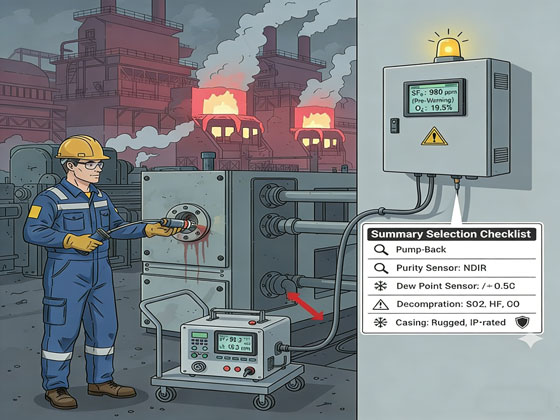
Pump-Back Feature: Industrial sites have strict “Zero Emission” policies. Ensure the SF6 gas analyzer has an internal compressor to pump the sampled gas back into the equipment after testing.
Dust Protection: Select units with built-in 1 micron particulate filters at the inlet to protect sensors from iron filings and industrial grit.
Metallurgical facilities are often high-vibration areas, which can cause flange seals to loosen over time.
Handheld Sniffers: Look for Infrared (IR) technology rather than corona discharge. IR sniffers are “blind” to humidity and common industrial VOCs (Volatile Organic Compounds), preventing false alarms in the chemically complex air of a steel plant.
Sensitivity Threshold: The device must detect at least 1.0 ppm (or 0.5g/year) to meet the standard leakage rate requirement of less than or equal to 0.1% per year.
Optical Gas Imaging (OGI): For large 110kV to 500kV GIS bays, an SF6 Thermal Camera is recommended. It allows you to “see” gas plumes from a safe distance, which is critical if equipment is located near high-heat sources like electric arc furnaces (EAF).
Since SF6 is 5 times heavier than air, it pools in cable trenches and pits—common in metallurgical plant layouts.
Oxygen Deficiency Monitoring: A compliance-grade system must monitor both SF6 concentration and O2 levels.
Alarm Thresholds: The system should trigger a pre-warning at 800 ppm and a critical alarm with automated ventilation at 1,000 ppm.
Ruggedized Enclosures: Sensors should be rated at least IP65 to withstand the washdowns and dust typical of heavy industry.
| Feature | Requirement for Metallurgy | Why it Matters |
| Purity Sensor | NDIR (Direct Measurement) | Accurate despite industrial contaminants. |
| Dew Point Sensor | Chilled Mirror or High-Grade Polymer | +/- 0.5 degrees Celsius accuracy is vital for insulation. |
| Decomposition | SO2, HF, and CO Monitoring | Detects internal arcing from high-cycle switching. |
| Casing | Rugged, IP-rated, anti-vibration | Equipment must survive transport over uneven plant floors. |
| Compliance | IEC 62271-203 & IEC 60480 | Legal requirement for equipment acceptance. |