
2026-03-19
If you have any needs regarding SF6 gas recovery, purification, and recycling, please feel free to contact us using the information below! We offer high-quality, standardized SF6 gas processing equipment that ensures the purity of recycled SF6 gas and helps you save on the cost of purchasing new gas.
| Phone Number: | +86-0371-68988008 |
|---|---|
| Email: | [email protected] |
| Address: | High-new Tech Zone Zhengzhou, Henan, China |
In the high-voltage power industry, the integrity of Sulfur Hexafluoride (SF6) insulation is non-negotiable. As global regulations on greenhouse gas emissions tighten, utility providers and industrial plants are seeking the top SF6 gas leak detection and analysis equipment to ensure grid reliability and environmental compliance.
When requesting a manufacturer quotation, it is essential to look beyond the price tag and evaluate the total cost of ownership, technical precision, and the equipment’s ability to operate in rugged field environments.
Choosing a top-tier manufacturer ensures your maintenance team is equipped with tools that offer more than just basic readings. The primary advantages of modern detection and analysis suites include:
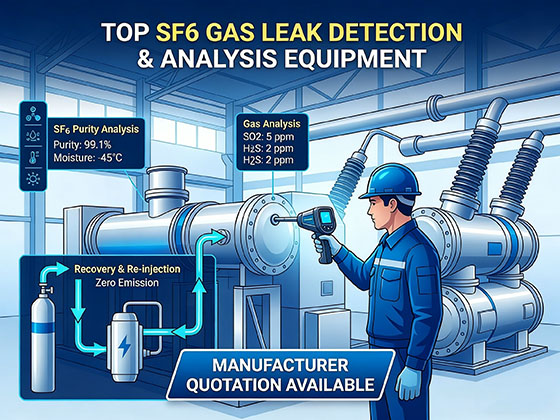
Top-rated equipment doesn’t just detect leaks; it analyzes the “health” of the gas. Advanced units simultaneously measure:
Purity: Ensuring SF6 levels remain above 98%.
Moisture (Dew Point): Preventing the formation of corrosive hydrofluoric acid.
Decomposition Products: Detecting SO2 and H2S, which serve as early warning signs of internal arcing.
Modern handheld detectors utilize Infrared (IR) absorption or Ionization technology to pinpoint leaks as small as 0.1 grams per year. This precision allows for the “search and repair” of micro-leaks before they evolve into catastrophic insulation failures.
To comply with “Net Zero” initiatives, leading manufacturers now provide integrated recovery and re-injection functions. This ensures that gas used for analysis is not vented into the atmosphere but is instead returned to the gas chamber or a storage cylinder.
When comparing quotations, ensure the technical specifications meet international standards such as IEC 60376. Below are the benchmark parameters for professional-grade equipment:
| Parameter | Performance Standard | Technology |
| Leak Sensitivity | < 1 ppm or 0.1 g/y | Infrared (NDIR) |
| SF6 Purity Accuracy | +/- 0.5% | Thermal Conductivity |
| Moisture Range | -60 degrees C to +20 degrees C | TDLAS (Laser) or Polymer |
| SO2 Detection | 0 to 100 ppm | Electrochemical |
| Data Logging | > 10,000 Records | USB/Bluetooth Export |
During the commissioning of new Gas-Insulated Switchgear (GIS), leak detection is the final gatekeeper of quality. A portable, high-sensitivity detector is used to sweep every flange and seal to guarantee a “leak-free” installation for the next 20 years of service.
In aluminum smelting or steel production, electromagnetic interference (EMI) is high. Top-tier equipment is designed with EMI shielding and ruggedized “trolley-case” housings to ensure accurate analysis despite the proximity to high-current furnaces.
Procuring directly from a specialized manufacturer offers several strategic benefits:
Customized Solutions: Ability to choose between laser or resistive humidity sensors based on your specific climate.
Calibration and Support: Direct access to factory calibration services to maintain the high precision required by regulatory bodies.
Expert Diagnosis Systems: Integrated software that automatically evaluates gas quality against industry “Expert Systems,” reducing the burden on field technicians.
Investing in the top SF6 gas leak detection and analysis equipment is a proactive step toward zero-fault operation and environmental stewardship. By focusing on high-accuracy sensors, zero-emission recovery features, and rugged portability, your facility can ensure that SF6 remains a reliable asset rather than a liability.
According to international standards like IEC 62271-4, the maximum allowable leakage rate for most modern GIS equipment is 0.5% per year. To maintain this standard, manufacturers recommend using high-sensitivity infrared (NDIR) detectors capable of identifying leaks as small as 0.1 grams per year during routine maintenance and commissioning.
Sulfur Dioxide (SO2) and Hydrogen Sulfide (H2S) are chemical “byproducts” that form when SF6 gas is exposed to electrical arcing or partial discharges. Detecting these gases is critical because they are highly corrosive and toxic. Their presence serves as an early warning sign of internal equipment faults, allowing for condition-based maintenance before a catastrophic failure occurs.
Laser (TDLAS): Offers a rapid response time (under 30 seconds) and is highly resistant to contamination. It is the gold standard for high-precision commissioning.
Resistive/Capacitive: These are robust, cost-effective sensors suitable for routine checks in stable environments. Top manufacturers often offer both to match the specific climatic and industrial conditions of the substation.
A “Zero-Emission” or “Zero-Loss” analyzer features an internal recovery and re-injection system. During the testing process, the sampled gas is captured in a small internal buffer tank. Once the analysis is complete, the unit uses a micro-compressor to pump the gas back into the switchgear or an external cylinder, ensuring no greenhouse gas is vented into the atmosphere.
While specific utility protocols vary, the industry standard is to perform a comprehensive gas analysis and leak sweep during commissioning, then at 3 to 5-year intervals, or immediately following a major fault event. Regular testing ensures that the gas purity remains above 98%, protecting the long-term dielectric integrity of the high-voltage asset.