
2026-07-20
If you have any needs regarding SF6 gas recovery, purification, and recycling, please feel free to contact us using the information below! We offer high-quality, standardized SF6 gas processing equipment that ensures the purity of recycled SF6 gas and helps you save on the cost of purchasing new gas.
| Phone Number: | +86-0371-68988008 |
|---|---|
| Email: | [email protected] |
| Address: | High-new Tech Zone Zhengzhou, Henan, China |
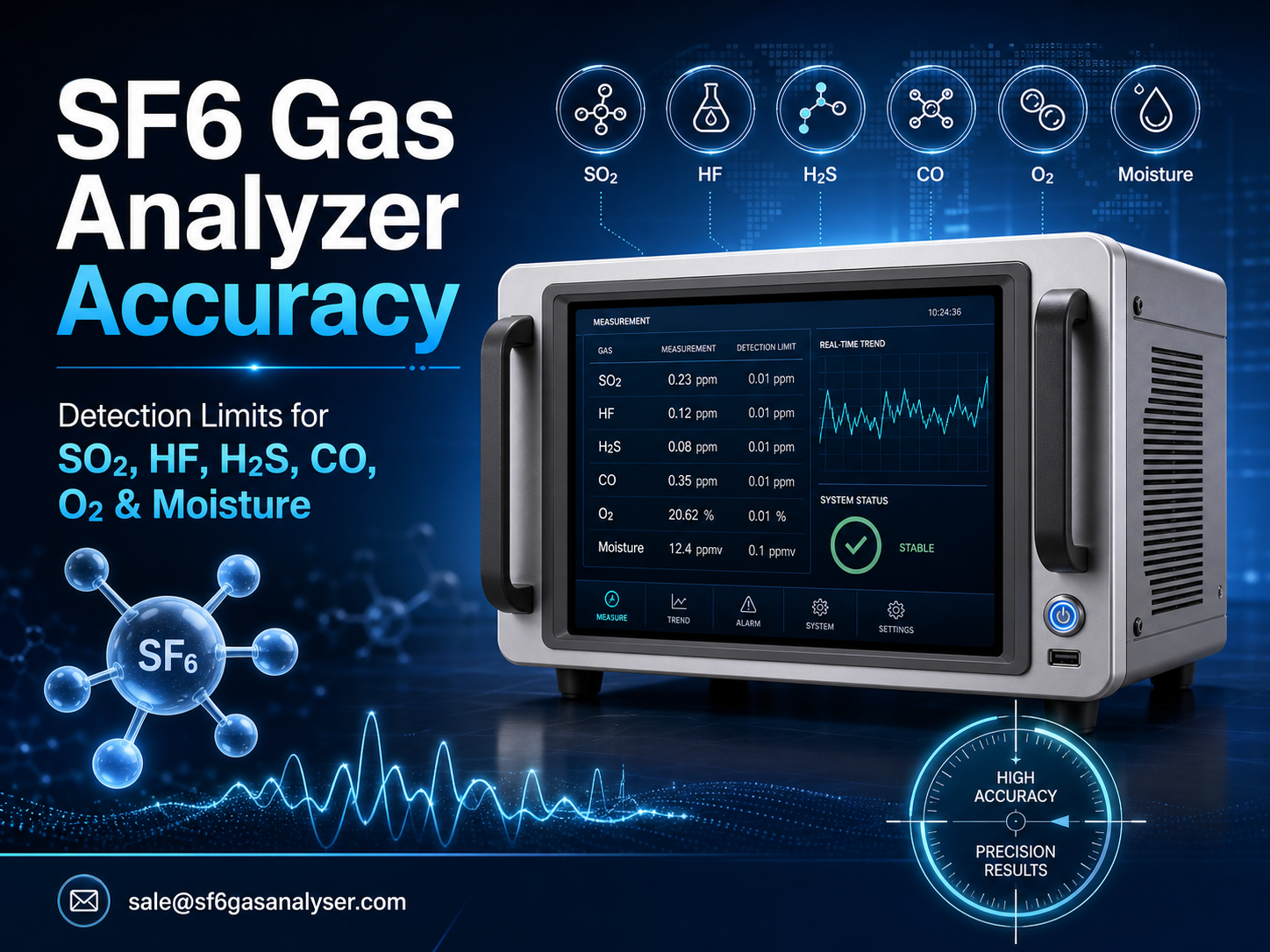
In high-voltage gas-insulated switchgear (GIS), circuit breakers, and other SF6-insulated electrical equipment, gas quality directly affects insulation performance, arc-quenching reliability, and asset safety. A professional sf6 gas analyzer is used to verify SF6 purity and identify decomposition by-products such as SO2, HF, H2S, CO, oxygen, and moisture. Understanding the expected detection limits and accuracies for measuring SO2, HF, H2S, CO, O2, and moisture helps utilities, substations, testing companies, and equipment manufacturers select the right instrument and interpret field results correctly.
SF6 gas analysis is not only a maintenance practice; it is also part of responsible asset management. International standards such as IEC 60480, IEC 60376, IEC 62271 series, and relevant CIGRE recommendations emphasize the importance of monitoring SF6 quality, decomposition products, and humidity to ensure safe operation and proper gas handling.
Detection limit refers to the lowest concentration an analyzer can reliably detect, while accuracy indicates how close the measured value is to the true value. For SF6 systems, both parameters are critical because decomposition products may appear at low ppm levels before visible equipment failure occurs.
A high-performance sf6 gas analyzer should provide stable measurement of trace gases under field conditions, including variations in pressure, temperature, and gas flow. For maintenance teams, reliable readings support decisions such as whether to continue operation, schedule inspection, filter or reclaim gas, or investigate internal arcing, overheating, moisture ingress, or contamination.
SO2, HF, H2S, and CO are commonly associated with electrical discharge, thermal faults, and reactions between SF6 decomposition products and internal materials. Oxygen and moisture are typically indicators of air ingress, poor gas handling, leakage, or inadequate evacuation before filling. When these parameters are measured together, they provide a more complete picture of equipment condition.
The required specification depends on whether the application is routine gas quality inspection, fault diagnosis, commissioning, or laboratory verification. However, the following values represent practical expectations for modern portable SF6 gas analysis equipment used in substations and industrial high-voltage applications.
Sulfur dioxide is one of the most important indicators of SF6 decomposition. It is usually measured in ppm by volume.
A good field-grade analyzer should typically offer:
For routine GIS maintenance, a detection limit of 1 ppm is generally adequate. For early fault identification or research-level diagnostics, 0.1 ppm resolution is preferred.
Hydrogen fluoride is highly reactive and corrosive. It may be formed when SF6 decomposition products react with moisture and internal materials. HF measurement is technically challenging because the gas can adsorb onto tubing and sampling components.
Expected performance:
Because HF is aggressive, the instrument design must use compatible materials. Users should avoid long sampling lines and should follow the manufacturer’s purging procedure to reduce memory effects.
Hydrogen sulfide may appear due to complex chemical reactions after discharge or contamination. It is normally present at low concentrations.
Typical specifications:
H2S readings should be interpreted together with SO2, moisture, and equipment history, because isolated low-level readings may require confirmation through repeat testing.
Carbon monoxide may indicate overheating, organic insulation degradation, or contamination from internal materials. It is especially useful when evaluating possible thermal faults.
Common analyzer capability:
For most field applications, CO measurement with 1 ppm resolution is sufficient. In fault investigation, trend analysis is often more valuable than a single reading.
Oxygen is measured to assess air contamination and gas handling quality. Elevated O2 may suggest leakage, improper evacuation, or mixing with air during service.
Typical specifications:
In SF6 systems, oxygen concentration should normally remain very low. The acceptable limit depends on company procedures, equipment type, and applicable standards.
Moisture is one of the most critical parameters because it affects insulation strength and can contribute to corrosive by-product formation. Moisture is often expressed as ppmv, dew point, or frost point.
Expected analyzer performance:
For high-voltage SF6 systems, moisture measurement should be pressure-compensated or converted correctly according to operating conditions. Users should ensure that the analyzer reports moisture in the required unit for their maintenance standard.
Below is a practical reference specification for selecting a multi-gas analyzer for measuring SO2, HF, H2S, CO, O2, and moisture in SF6-insulated equipment.
| Parameter | Recommended Technical Specification |
|---|---|
| Applicable gas | SF6 and SF6 gas mixtures, depending on model configuration |
| SO2 range / detection limit | 0–100 ppm or 0–500 ppm / 0.1–1 ppm |
| HF range / detection limit | 0–10 ppm or 0–50 ppm / 0.1–1 ppm |
| H2S range / detection limit | 0–100 ppm / 0.1–1 ppm |
| CO range / detection limit | 0–500 ppm or 0–1000 ppm / 1 ppm or better |
| O2 range / resolution | 0–5%, 0–25% or customized / 0.01–0.1% |
| Moisture range | -80°C to +20°C dew point, or ppmv equivalent |
| Moisture accuracy | Typically ±2°C dew point |
| Gas flow | Usually 0.2–1.0 L/min, depending on sensor configuration |
| Sampling method | Pump-assisted or pressure-fed sampling |
| Data output | USB, Bluetooth, RS232/RS485, or digital report export |
| Operating environment | Field-portable, suitable for substation maintenance conditions |
| Compliance reference | IEC 60480, IEC 60376, IEC 62271-related maintenance practices |
For a model configuration matched to your switchgear type and maintenance standard, you can request a free technical consultation via [email protected].
Periodic gas testing helps detect abnormal decomposition gases before faults become serious. Maintenance teams commonly measure SF6 purity, SO2, moisture, and oxygen during scheduled inspections.
When partial discharge, internal arcing, or abnormal heating is suspected, measuring SO2, HF, H2S, CO, O2, and moisture provides evidence for condition assessment. Higher SO2 and HF may indicate electrical decomposition, while CO may suggest thermal degradation of internal materials.
Before energizing new equipment, gas quality should be verified. Low moisture and low oxygen levels confirm proper evacuation and filling procedures. This supports compliance with commissioning standards and reduces early-life failure risk.
During gas reclamation, decomposition products and moisture must be checked to determine whether gas can be reused, filtered, or sent for further treatment. A calibrated sf6 gas analyzer supports environmentally responsible SF6 management.
For customized on-site SF6 gas testing and recovery solutions, contact the engineering team at [email protected].
If your main task is routine inspection, standard ppm-level detection is usually sufficient. If you are performing early fault diagnosis, select lower detection limits, especially for SO2, HF, and H2S.
SF6 decomposition gas measurement can be affected by cross-sensitivity. Choose analyzers with compensation algorithms, verified sensor selectivity, and clear calibration certificates.
For professional SF6 maintenance, dew point accuracy and pressure compensation are essential. Instruments should clearly display moisture in dew point, ppmv, or both.
A practical analyzer should minimize SF6 emissions. Closed-loop sampling, gas return bags, or built-in recovery options help support environmental compliance and responsible gas handling.
Select equipment with factory calibration, traceable certificates, and recommended calibration intervals. For critical infrastructure, annual calibration is commonly recommended, although the interval should follow the manufacturer’s instructions and internal quality procedures.
Portable design, fast warm-up, stable flow control, intuitive reporting, and rugged connectors improve efficiency in substations. Data logging is especially important for trend analysis and audit records.
For one-on-one selection guidance from SF6 testing engineers, send your application details to [email protected].
For most field maintenance, 1 ppm is acceptable. For advanced diagnostics or early fault detection, 0.1 ppm is preferred. Accuracy of ±0.5 ppm or ±2% to ±5% of reading is typical for quality instruments.
HF is corrosive and easily adsorbed by tubing and sampling surfaces. Accurate HF measurement requires compatible gas paths, short sampling lines, proper purging, and regular calibration.
Both are important. Moisture affects dielectric strength and accelerates corrosive reactions, while decomposition gases indicate electrical or thermal stress. A complete SF6 condition assessment should include both moisture and gas by-products.
Most manufacturers recommend annual calibration, but the correct interval depends on usage frequency, sensor type, site requirements, and quality management procedures. Instruments used for regulatory or critical asset testing should follow traceable calibration practices.
Many modern multi-gas analyzers can measure SO2, HF, H2S, CO, O2, and moisture in one portable system. However, sensor configuration, detection limits, and sampling materials should be selected according to the specific application.
The expected detection limits and accuracies for measuring SO2, HF, H2S, CO, O2, and moisture in SF6 systems vary by instrument class and maintenance objective. As a practical benchmark, SO2, HF, and H2S detection limits of 0.1–1 ppm, CO detection around 1 ppm, oxygen resolution down to 0.01–0.1%, and moisture accuracy around ±2°C dew point represent strong field performance. Choosing the right sf6 gas analyzer ensures reliable diagnostics, safer high-voltage operation, improved compliance, and better long-term asset management.