
2026-02-06
If you have any needs regarding SF6 gas recovery, purification, and recycling, please feel free to contact us using the information below! We offer high-quality, standardized SF6 gas processing equipment that ensures the purity of recycled SF6 gas and helps you save on the cost of purchasing new gas.
| Phone Number: | +86-0371-68988008 |
|---|---|
| Email: | [email protected] |
| Address: | High-new Tech Zone Zhengzhou, Henan, China |
In the ultra-precision environment of semiconductor manufacturing, the purity of process gases is the foundation of device reliability and manufacturing yield. While Sulfur Hexafluoride (SF6) is traditionally associated with high-voltage electrical insulation, it plays a critical role in the semiconductor industry, particularly in plasma etching and specialized cleaning steps within the photolithography cluster.
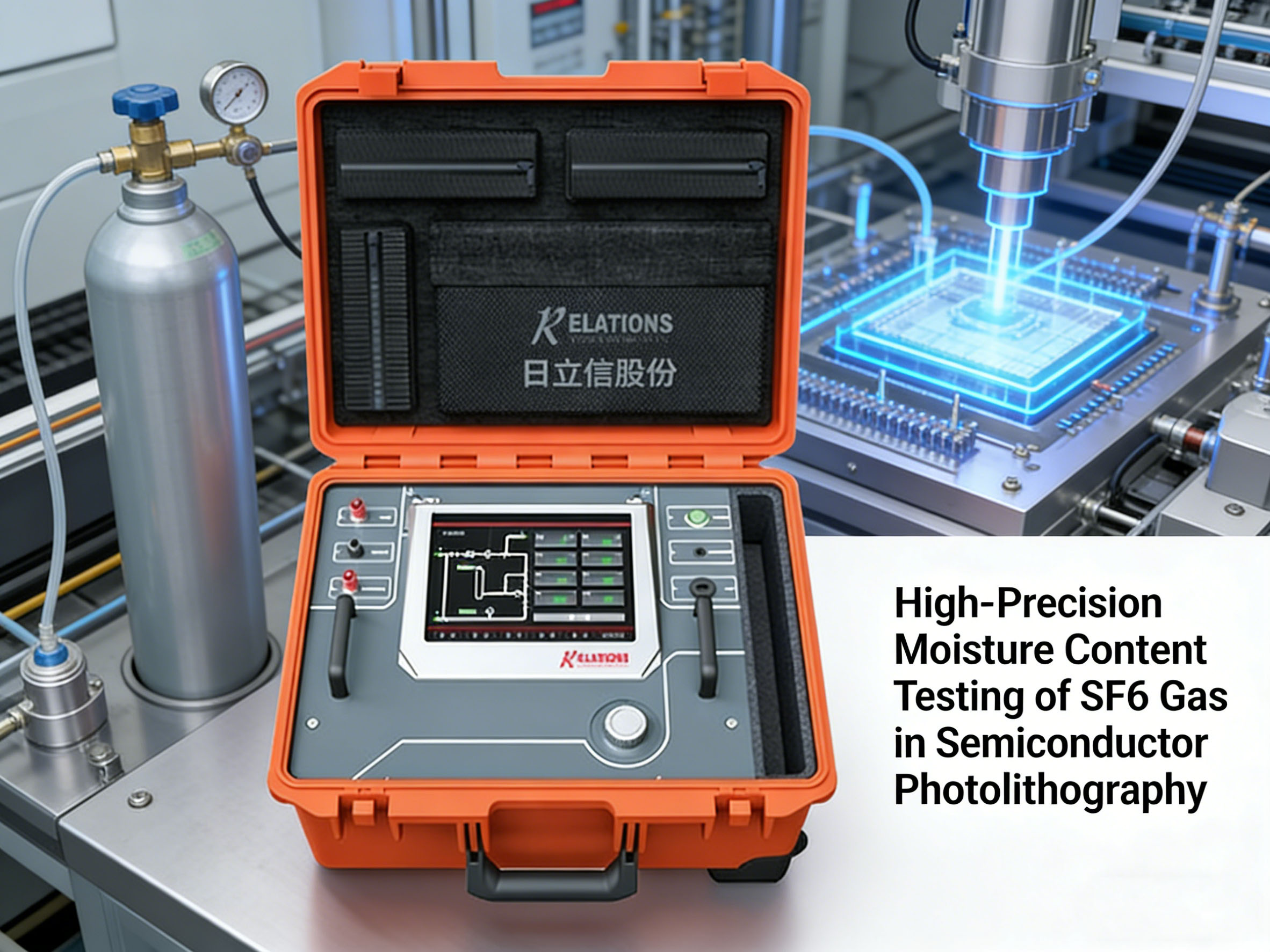
However, the presence of contaminants—specifically water vapor—can lead to catastrophic chemical imbalances. Moisture content testing of SF6 gas in semiconductor photolithography process has therefore become a mandatory quality control benchmark. By utilizing advanced integrated SF6 gas analyzers, manufacturers ensure that SF6 remains a pure, predictable medium for high-aspect-ratio etching and surface modification.
In photolithography and subsequent etching stages, SF6 serves as a source of fluorine ions in reactive ion etching (RIE) and deep reactive ion etching (DRIE). Its high fluorine content and stability are essential for anisotropic etching, which creates deep, vertical trenches in silicon substrates; chamber cleaning to remove residue from Chemical Vapor Deposition (CVD) tools; and surface passivation to modify surface energy to improve photoresist adhesion.
The effectiveness of these processes relies on strictly controlled plasma chemistry. Even trace amounts of moisture react with the fluorine plasma to form Hydrofluoric Acid (HF), leading to uncontrolled isotropic etching, critical dimension (CD) loss, and structural damage to delicate photoresist patterns.
Moisture content testing of SF6 gas in semiconductor photolithography process addresses several high-risk failure modes that occur when SF6 is compromised. Water vapor reacts with SF6 under high-energy plasma conditions to produce HF, SO2, and other oxyfluorides, which are highly corrosive to the internal components of the photolithography track and vacuum systems. Additionally, because water has a lower ionization potential than SF6, moisture alters the electron temperature and plasma density, resulting in inconsistent etch rates. Finally, moisture facilitates the nucleation of solid decomposition products; these sub-micron particles act as “killer defects,” breaking conductive traces or causing short circuits on the wafer surface.
Modern semiconductor facilities require diagnostic tools that offer more than simple humidity readings. A professional portable SF6 gas analyzer acts as a multi-parameter diagnostic hub designed for cleanroom requirements.
Laser-based moisture detection is preferred for semiconductor applications, offering a response time of 30 seconds or less and detecting dew points down to -60°C with ±1°C accuracy. Integrated analyzers also use thermal conductivity sensors to ensure SF6 purity remains above 99.9%, flagging any air or carrier gas leaks, while electrochemical analysis monitors SO2, CO, and H2S to provide a secondary check on gas stability.
For process engineers, the following parameters define a high-performance analyzer suitable for the photolithography cluster: a moisture range (dew point) of -60 to +20°C for trace humidity detection, SF6 purity accuracy of ±0.5% to validate gas grade, and the ability to detect decomposition products like SO2, H2S, and CO. The device should support an input pressure range of 0.4 to 2 MPa to be compatible with cleanroom gas manifolds and include an integrated expert diagnosis system for automatic compliance checks.
In line with global ESG (Environmental, Social, and Governance) standards, semiconductor fabs must reduce their greenhouse gas footprint. A high-tier SF6 gas analyzer features an integrated recovery system where gas can be returned to the sampling chamber after analysis or recovered into a storage cylinder at pressures up to 0.8 MPa. This closed-loop functionality ensures the facility meets “Zero Emission” goals while maintaining rigorous testing frequencies.
Integrating moisture testing into the Standard Operating Procedure (SOP) involves three stages. Incoming gas verification prevents “upstream contamination” before cylinders connect to the gas cabinet. Point-of-use (POU) monitoring involves testing at the etch tool inlet to ensure no moisture has permeated through high-purity piping. Finally, post-recovery validation verifies recovered gas purity before it is reintroduced into the supply chain.
In semiconductor manufacturing, the difference between high-yield and failure often comes down to parts-per-million. Moisture content testing of SF6 gas in semiconductor photolithography process is a vital component of process optimization. By utilizing multi-functional, zero-emission gas analyzers, manufacturers protect their hardware, ensure consistent etch profiles, and adhere to environmental regulations.