
2026-04-01
If you have any needs regarding SF6 gas recovery, purification, and recycling, please feel free to contact us using the information below! We offer high-quality, standardized SF6 gas processing equipment that ensures the purity of recycled SF6 gas and helps you save on the cost of purchasing new gas.
| Phone Number: | +86-0371-68988008 |
|---|---|
| Email: | [email protected] |
| Address: | High-new Tech Zone Zhengzhou, Henan, China |
In the management of high-voltage power infrastructure, Sulfur Hexafluoride (SF6) is the most critical component for insulation and arc suppression. However, its effectiveness is not permanent. For asset managers and maintenance engineers, the question “How often should SF6 gas in a substation be tested or treated?” is central to preventing catastrophic equipment failure and ensuring environmental compliance.
While specific intervals can vary based on equipment age and load, sticking to a standardized testing roadmap is the only way to guarantee 99.9% grid reliability.
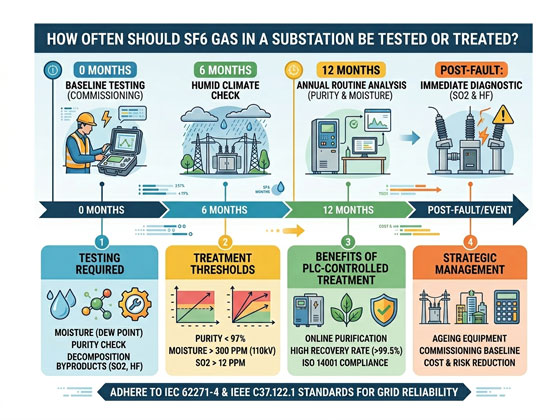
Most international standards, including IEC 62271-4 and IEEE C37.122.1, recommend a tiered approach to SF6 gas analysis.
Annual Routine Checks: At a minimum, moisture (dew point) and purity levels should be tested once every 12 months. This identifies slow-leaking seals or early-stage decomposition.
Post-Fault Testing: After any major switching operation or circuit breaker trip, the gas must be tested immediately for SO2 (Sulfur Dioxide) and HF (Hydrogen Fluoride) to assess internal arcing damage.
Continuous Monitoring: For critical 500kV Ultra-High Voltage (UHV) substations, transitioning to SF6 online monitoring systems is recommended to provide 24/7 data on density and leakage.
Testing frequency is only half the battle; knowing when to “treat” or purify the gas is equally vital. Treatment should be initiated immediately if the following technical parameters are breached:
| Parameter | Normal Range | Treatment Threshold |
| Gas Purity | 99.0% or higher | Below 97.0% |
| Moisture Content | Less than 150 ppm (110kV) | Above 300 ppm (110kV) |
| SO2 Concentration | Less than 1 ppm | Above 12 ppm (Indicates severe arcing) |
| Acidity (HF) | Less than 0.1 ppm | Above 0.3 ppm (Corrosive risk) |
When testing reveals contamination, the traditional response was costly gas replacement. Modern PLC-controlled SF6 recovery and purification units have changed this dynamic.
Online Purification: Advanced units can treat the gas while the equipment remains energized (in specific GIS configurations), removing moisture and acidic byproducts without a shutdown.
High-Precision Recovery: These systems achieve a recovery rate of over 99.5%, ensuring that no gas is lost to the atmosphere during the treatment process, supporting your ISO 14001 goals.
Oil-Free Compression: Utilizing oil-less SF6 compressors during treatment prevents the introduction of new contaminants, extending the life of the breaker by years.
The “How Often” answer also depends on the installation environment:
Coastal or Humid Regions: High-humidity environments may require bi-annual moisture testing (every 6 months) to prevent the formation of HF acid inside the GIS.
Aging Substations: Equipment older than 15 years should be tested more frequently for seal integrity and decomposition markers.
New Commissioning: Always perform a full purity and moisture baseline test within 6 months of initial energization to ensure no assembly-phase contamination remains.
The answer to “How often should SF6 gas in a substation be tested or treated?” is a combination of annual discipline and event-driven vigilance. By implementing a strict testing schedule and utilizing high-performance purification technology, utilities can avoid the high costs of unplanned outages and environmental penalties.
Is your testing schedule up to 2026 standards? Contact us for a free consultation on SF6 gas testing intervals and professional purification solutions.