
2026-03-19
If you have any needs regarding SF6 gas recovery, purification, and recycling, please feel free to contact us using the information below! We offer high-quality, standardized SF6 gas processing equipment that ensures the purity of recycled SF6 gas and helps you save on the cost of purchasing new gas.
| Phone Number: | +86-0371-68988008 |
|---|---|
| Email: | [email protected] |
| Address: | High-new Tech Zone Zhengzhou, Henan, China |
In the power transmission and distribution industry, maintaining the integrity of sulfur hexafluoride (SF6) insulation is critical for both operational reliability and environmental compliance. A common question among substation managers and O&M engineers is: What is the standard leak rate for SF6 in High-Voltage Gas-Insulated Switchgear (GIS)?
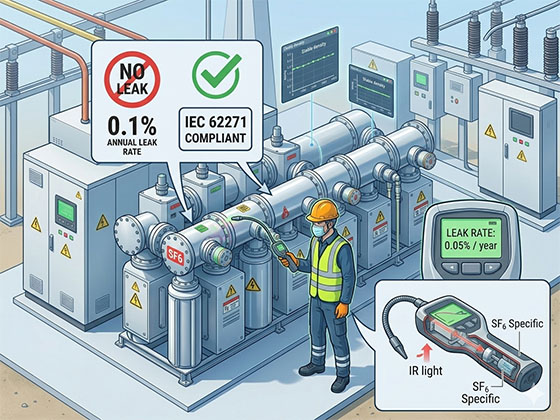
According to international standards like IEC 62271-203 and IEC 62271-1, the industry-accepted maximum leakage rate for new GIS equipment is less than or equal to 0.1% per year per gas compartment.
The 0.1% annual leak rate is not just a random figure; it is a technical benchmark designed to ensure that the equipment remains safe for its entire service life (typically 30 to 40 years) without requiring frequent gas refills.
Dielectric Strength: SF6 must maintain a specific density to quench arcs effectively. Even a small drop in density can lead to catastrophic insulation failure.
Environmental Impact: SF6 is a potent greenhouse gas. Adhering to strict leak rates is essential for meeting global carbon reduction goals and avoiding heavy environmental fines.
Equipment Longevity: Low leak rates prevent the ingress of moisture and air, which can react with SF6 to form corrosive byproducts like SO2 and HF.
To verify that your GIS meets the 0.1% standard, you need high-precision diagnostic tools. Our suite of SF6 maintenance equipment is engineered to detect even the most minute deviations from this benchmark.
| Parameter | Compliance Requirement | Our Product Capability |
| Annual Leakage Rate | Less than or equal to 0.1% | Detects leaks as small as 0.01% / year |
| Detection Sensitivity | 1.0 ppm (minimum) | 0.1 ppm (High-precision NDIR) |
| Gas Purity | Over 97% (IEC 60376) | 0.01% resolution measurement |
| Moisture Content | Less than 150 ppmv (typical) | +/- 0.5 degrees Celsius dew point accuracy |
During the commissioning of a new 220kV GIS substation, the 0.1% leak rate must be verified before the equipment is energized. Our High-Precision SF6 Leak Detector is used to perform “bagging” tests on all flange joints, ensuring that no assembly errors occurred during installation that could lead to long-term seepage.
For GIS units that have been in service for over 20 years, seals may begin to degrade. In this scenario, we recommend an Online SF6 Gas Density Monitoring System. By trending data over time, the system can predict when a compartment is approaching the 0.1% limit, allowing for planned maintenance before a low-pressure alarm occurs.
Our SF6 diagnostic tools are specifically designed to help utilities maintain the 0.1% standard:
Zero False Positives: Utilizing Non-Dispersive Infrared (NDIR) technology, our detectors are unaffected by humidity or background gases, ensuring that every alarm is a real leak.
Rapid Quantization: Our software can convert ppm (parts per million) readings into actual gram-per-year leak rates, giving you the exact data needed for regulatory reporting.
Ruggedized for Field Use: With IP65-rated enclosures and high-contrast OLED screens, our tools are built for the harsh environments of high-voltage substations.
Understanding and maintaining the standard leak rate for SF6 is the foundation of a proactive asset management strategy. By combining the 0.1% benchmark with advanced NDIR detection and real-time density monitoring, utilities can ensure a safer, greener, and more reliable power grid.
According to international standards IEC 62271-203, the maximum allowable leak rate for new High-Voltage Gas-Insulated Switchgear (GIS) is 0.1% per year per gas compartment. This stringent limit ensures that the equipment can operate safely for its designed lifespan—often 30 to 40 years—without requiring frequent gas top-ups that could compromise dielectric strength.
To convert a concentration reading (ppm) into a standardized annual leak rate (grams per year), you typically perform a “Sniffing” or “Bagging” test. The technician wraps the joint in a sealed plastic bag for a set period (e.g., 2 hours). The accumulated concentration is then measured with a high-precision NDIR SF6 leak detector, and the resulting ppm increase is calculated against the volume of the bag to determine the mass loss over time.
Yes, ambient temperature significantly impacts gas pressure, which can influence the flow rate of a leak. However, the standard 0.1% leak rate is a density-based measurement. To accurately track leaks in variable climates, maintenance teams must use temperature-compensated gas density sensors that normalize all readings to 20°C, ensuring that pressure drops are caused by actual gas loss rather than cold weather.
While 0.1% is the legal “pass/fail” limit for new equipment, detecting “micro-leaks” (as low as 0.01%) is a critical part of predictive maintenance. Identifying a seal that is beginning to fail allow’s O&M teams to schedule repairs during planned outages. This prevents emergency shutdowns and reduces the environmental liability associated with the cumulative release of greenhouse gases.
Penalties vary by region, but under regulations like the EU F-Gas Regulation or various EPA reporting mandates, utilities can face significant financial fines for failing to report or repair SF6 leaks. Beyond fines, excessive leakage can damage a company’s ESG (Environmental, Social, and Governance) rating, potentially impacting investor relations and public standing.