
2026-06-15
If you have any needs regarding SF6 gas recovery, purification, and recycling, please feel free to contact us using the information below! We offer high-quality, standardized SF6 gas processing equipment that ensures the purity of recycled SF6 gas and helps you save on the cost of purchasing new gas.
| Phone Number: | +86-0371-68988008 |
|---|---|
| Email: | [email protected] |
| Address: | High-new Tech Zone Zhengzhou, Henan, China |
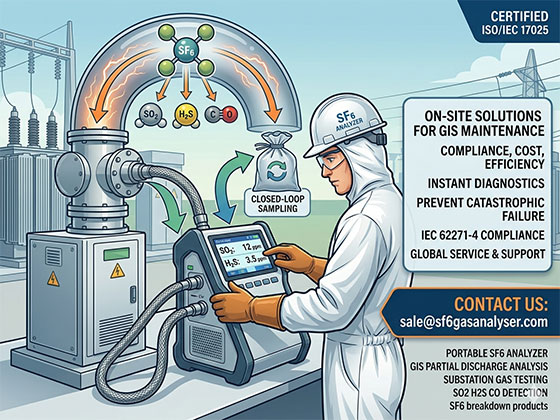
On-site SF6 decomposition product detection solutions are specialized field-ready analytical systems designed to identify and measure toxic byproduct gases—such as SO2, H2S, HF, and CO—formed when sulfur hexafluoride gas degrades under electrical stress inside Gas Insulated Switchgear (GIS). These solutions combine advanced electrochemical or optical sensors with portable, rugged enclosures to deliver immediate, laboratory-grade gas purity analysis directly at the substation. By providing real-time data, they allow maintenance teams to immediately diagnose internal arcing or partial discharges, ensuring regulatory compliance, preventing catastrophic equipment failure, and eliminating the downtime and costs associated with shipping hazardous gas samples to remote laboratories.
Maintaining high-voltage assets requires a balance of safety, environmental compliance, and cost management. As regulatory frameworks tighten globally, asset managers can no longer rely on slow, reactive maintenance strategies.
Rigid Global Compliance: International frameworks like IEC 62271-4 and the EU F-Gas Regulation 2024/573 enforce strict monitoring of insulating gases. Utilizing dedicated field instruments ensures your facility maintains legally defensible data logs to satisfy environmental audits.
Predictive Cost Reductions: Acidic decomposition products like Hydrogen Fluoride (HF) degrade internal GIS components. Early identification prevents catastrophic failures, saving utilities hundreds of thousands of dollars in emergency equipment replacement.
Downtime Elimination: Traditional laboratory testing cycles can take weeks. Portable field testing equipment delivers accurate concentration readouts within minutes, allowing maintenance crews to make rapid, data-driven decisions during scheduled outages.
For engineering teams seeking customized technical specifications or pricing for localized maintenance projects, our support team provides comprehensive consulting. Get in touch at [email protected] to discuss your regional testing requirements.
Modern testing equipment must perform reliably across a variety of demanding field environments:
Periodic preventative health checks detect early-stage partial discharges or localized overheating before any visible or acoustic indicators surface.
Following an automated protection relay trip, rapid on-site analysis identifies the severity and nature of the internal fault (e.g., distinguishing between a minor spark discharge and high-energy arcing).
Field testing ensures that recovered gas meets the necessary purity baselines before it is passed through an SF6 gas purification system or reintroduced into high-voltage equipment.
To meet the stringent data integrity demands of global foreign trade buyers and EPC contractors, our On-site SF6 decomposition product detection solutions utilize high-precision sensor arrays designed for repeatable field performance.
| Technical Parameter | Standard Specification / Value |
| Target Decomposition Gases | SO2, H2S, CO (Optional: HF) |
| SO2 Measurement Range / Accuracy | 0 to 100 ppm / plus or minus 0.5 ppm (or plus or minus 5% of reading) |
| H2S Measurement Range / Accuracy | 0 to 100 ppm / plus or minus 0.5 ppm (or plus or minus 5% of reading) |
| CO Measurement Range / Accuracy | 0 to 500 ppm / plus or minus 1.0 ppm (or plus or minus 5% of reading) |
| Response Time (T90) | Less than 30 seconds |
| Gas Consumption Rate | ~200 mL / min |
| Data Storage Capacity | Minimum 10,000 data sets with timestamp |
| Connectivity & Interface | USB, Bluetooth, RS485; Full-color touch screen |
| Operating Temperature Range | -20 degrees Celsius to +50 degrees Celsius |
| Enclosure Protection Class | IP67 (Case closed), IP54 (Operational) |
International B2B procurement professionals look beyond basic hardware functionality. To ensure maximum return on investment, your selection framework should focus on three core pillars:
Ensure all hardware complies with global market access standards. Equipment should carry the CE Marking for European markets, explicit Ex-proof (Explosion-proof) ratings for hazardous environments, and calibration certificates traceable to ISO/IEC 17025 accredited laboratories.
Modern compliance mandates unmodifiable data logging. Look for systems featuring automated data storage, secure user permissions, and seamless export functions via USB or cloud interfaces to generate clean PDF compliance reports on demand.
Electrochemical sensors require calibration every 12 to 24 months. Partner with manufacturers that offer readily available calibration kits, localized technical support, and comprehensive video documentation to simplify field commissioning.
If you require compliance documentation, CE certificates, or a detailed technical quote for your procurement team, please contact our global sales desk at [email protected].
When partial discharges, localized overheating, or electric arcing occur, the stable SF6 molecule breaks apart. The resulting free sulfur and fluorine atoms instantly react with trace moisture (H2O) and oxygen (O2) impurities inside the gas compartment, generating toxic byproducts like SO2, H2S, and CO.
For standard operational assets, testing is recommended every 1 to 3 years as part of a routine preventive maintenance program. However, testing should be conducted immediately following any unexpected protection relay trip or breaker operation.
Extreme temperatures and low humidity can cause sensor drift. High-tier field instruments integrate automated temperature and pressure compensation algorithms to ensure stable, repeatable readings across a wide range of ambient field conditions.
No. Modern environmental regulations strictly prohibit the intentional venting of greenhouse gases. Professional analyzer solutions utilize closed-loop sampling interfaces that direct the exhaust gas into a dedicated collection bag or permit low-pressure gas recovery.