
2026-03-20
If you have any needs regarding SF6 gas recovery, purification, and recycling, please feel free to contact us using the information below! We offer high-quality, standardized SF6 gas processing equipment that ensures the purity of recycled SF6 gas and helps you save on the cost of purchasing new gas.
| Phone Number: | +86-0371-68988008 |
|---|---|
| Email: | [email protected] |
| Address: | High-new Tech Zone Zhengzhou, Henan, China |
In the modern power industry, the reliability of a 110kV Gas Insulated Switchgear (GIS) substation depends entirely on the chemical stability and dielectric strength of Sulfur Hexafluoride (SF6). As we move through 2026, the shift toward “Green Grids” and zero-emission maintenance has made traditional gas testing methods obsolete. The implementation of a pump-back SF6 analyzer for 110kV GIS maintenance has emerged as the industry standard, combining high-precision diagnostics with a sustainable, closed-loop gas handling protocol.
A 110kV GIS bay is a compact, high-performance asset where space is a premium and insulation integrity is non-negotiable. Even minor moisture ingress or the presence of decomposition products like Sulfur Dioxide (SO2) or Hydrogen Sulfide (H2S) can lead to partial discharge or catastrophic flashover.
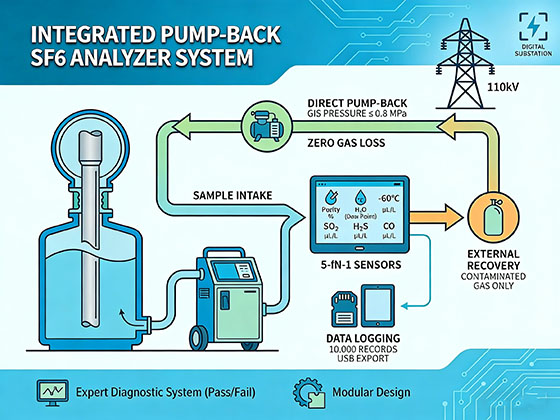
Historically, field technicians faced a dilemma: vent a small amount of gas during testing or carry cumbersome external recovery bags. The modern pump-back SF6 analyzer solves this by integrating measurement, recovery, and re-injection into a single automated workflow.
The defining feature of this pump-back SF6 analyzer is its ability to eliminate gas loss entirely. By achieving the goal of zero-pollution and zero-loss, it aligns perfectly with the 2026 regulatory environment regarding fluorinated gases.
Equipped with a high-efficiency micro-compressor, the device can overcome internal GIS pressures to return sampled gas directly to the 110kV pressure switch. With a return pressure capacity of 0.8 MPa or less, it ensures that the gas density inside the bay remains constant, preventing low-pressure alarms during routine maintenance.
In scenarios where the sampled gas is found to be highly contaminated—making it unsuitable for immediate re-injection—the system allows for recovery into external cylinders or specialized recovery bags (at atmospheric pressure). This dual-mode flexibility is critical for high-stakes maintenance where equipment safety and environmental protection must be balanced.
A pump-back SF6 analyzer for 110kV GIS maintenance must be more than a recovery tool; it must be a laboratory-grade diagnostic instrument. This system integrates the detection of five critical parameters into one operation.
The core insulation quality is determined by purity. Using high-stability thermal conductivity sensors, the SF6 gas analyzer measures concentration from 0% to 100% with a precision of +/-0.5%. Within 60 seconds or less, the system confirms if the gas meets the operational standard for arc quenching.
Moisture is the primary catalyst for insulation failure. The SF6 analyzer supports two measurement principles:
Laser Sensing: Offers rapid response (30 seconds or less) for high-frequency testing.
Resistive-Capacitive: Provides a wide measurement range from -60 to +20 degrees C, ideal for extreme environmental conditions.
The presence of Sulfur Dioxide, Hydrogen Sulfide, or Carbon Monoxide indicates internal arcing or overheating of solid insulation.
SO2 and H2S: Detection up to 100 uL/L allows technicians to catch early-stage insulation breakdown.
CO: Monitoring up to 500 uL/L provides a window into the health of internal organic insulation components.
Time is a critical factor during substation outages. The operational design of the SF6 analyzer is specifically tailored to minimize downtime in 110kV environments.
The “One-Key” measurement function automates the flow control—defaulting to an optimal 150 mL/min—and locks the final data once the sensors stabilize. This reduces the cognitive load on the technician and ensures repeatable, objective results across different bays.
Raw data can be difficult to interpret under field pressure. The integrated expert system automatically compares measured values against pre-selected industry standards (such as IEC or national power grid rules). It provides an immediate “Pass/Fail” verdict based on the selected standard, empowering technicians to make informed decisions on-site.
Maintenance of the SF6 analyzer itself is simplified through a unique modular design. If a specific sensor module (such as the SO2 electrochemical cell) requires calibration or replacement, it can be serviced without dismantling the entire unit, ensuring the device remains in service longer.
In the era of smart grids, data is as valuable as the gas itself. The pump-back SF6 analyzer for 110kV GIS maintenance serves as a data hub for asset health.
Massive Storage: With a capacity of up to 10,000 data sets, the device can store years of maintenance history for an entire substation.
USB Data Export: All records can be exported via USB, allowing for easy integration into the station’s Digital Twin or asset management software. This facilitates long-term trend analysis to predict equipment failure before it occurs.
| Parameter | Technical Value |
| Input Pressure Range | 0.4 to 2.0 MPa |
| Re-injection (Pump-back) Pressure | 0.8 MPa or less |
| Purity Range | 0% to 100% (Accuracy +/-0.5) |
| Response Time (Purity) | 60 seconds or less |
| Dew Point Range | -60 to +20 degrees C |
| Storage Capacity | 10,000 records |
| Mobility | Trolley-case with integrated wheels |
The use of a pump-back SF6 analyzer for 110kV GIS maintenance represents the intersection of technical excellence and environmental stewardship. By ensuring that every sample is either returned to the system or safely recovered, utilities can maintain the highest levels of grid reliability without compromising their carbon-neutrality targets.
With its high-precision sensors, automated workflow, and expert diagnostic capabilities, this analyzer is the definitive tool for the modern substation engineer. It ensures that 110kV GIS assets remain at peak performance while providing the data necessary for the next generation of predictive maintenance.