
2026-04-01
If you have any needs regarding SF6 gas recovery, purification, and recycling, please feel free to contact us using the information below! We offer high-quality, standardized SF6 gas processing equipment that ensures the purity of recycled SF6 gas and helps you save on the cost of purchasing new gas.
| Phone Number: | +86-0371-68988008 |
|---|---|
| Email: | [email protected] |
| Address: | High-new Tech Zone Zhengzhou, Henan, China |
In high-voltage power systems, Sulfur Hexafluoride (SF6) gas is the lifeline of insulation and arc quenching. However, the integrity of this gas is frequently compromised by moisture, air, and decomposition byproducts. When engineers ask, “What are the consequences of low SF6 purity in high-voltage circuit breakers?” they are often dealing with the hidden catalysts of catastrophic equipment failure.
Understanding these risks is the first step toward implementing a robust gas management strategy that ensures 99.9% uptime.
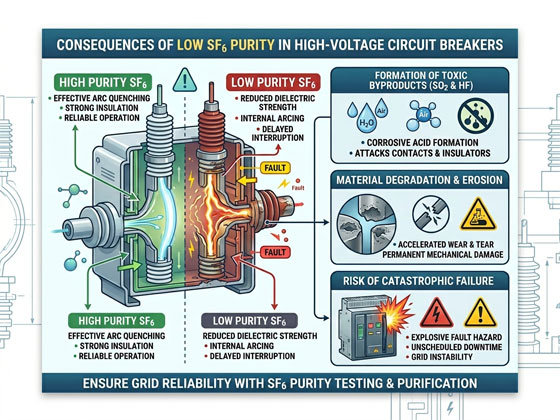
The most immediate consequence of low purity is the loss of insulating properties. If SF6 is contaminated with air or nitrogen, its ability to prevent electrical arcing is significantly diminished.
Internal Arcing: As purity drops, the gap between energized parts can no longer be bridged by the gas, leading to “flashovers.”
Partial Discharge (PD): Impurities act as conductive paths, triggering micro-discharges that slowly erode the internal components of the Gas-Insulated Switchgear (GIS).
When low-purity SF6 (specifically gas with high moisture content) is exposed to an electric arc, it doesn’t just lose efficiency—it becomes chemically aggressive.
Corrosive Byproducts: Moisture reacts with SF6 during arcing to form Sulfur Dioxide (SO2) and Hydrogen Fluoride (HF).
Material Degradation: These acidic byproducts attack the silver plating on contacts, ceramic insulators, and metal tank walls, leading to permanent mechanical damage.
High-voltage circuit breakers rely on the rapid cooling and electronegativity of SF6 to “snuff out” powerful electrical arcs during a fault.
Delayed Interruption: Low purity increases the time required to extinguish the arc. A delay of even a few milliseconds can result in the total destruction of the breaker or a cascading grid failure.
Thermal Instability: Contaminants change the thermal conductivity of the gas, preventing the efficient dissipation of heat generated during switching operations.
To avoid the negative consequences of low SF6 purity, utilities must adhere to strict purity benchmarks as defined by IEC 60480 and DL/T 596.
| Parameter | Maintenance Standard (IEC/ISO) | Risk Level |
| SF6 Purity | 99% or higher | Below 97% requires immediate recycling |
| Moisture (Dew Point) | -36 degrees C or lower | Above -25 degrees C causes acid formation |
| SO2 Content | Less than 12 ppm | High levels indicate severe internal arcing |
| Acidity | Less than 0.3 ppm | Corrosive to internal GIS components |
Effective gas management involves regular testing, especially in 500kV Ultra-High Voltage (UHV) substations where the electrical stress is highest.
Scenario: During a routine inspection of a 220kV circuit breaker, a portable SF6 purity analyzer detects a purity level of 96.5% and high SO2.
The Solution: Instead of a full gas replacement, a PLC-controlled SF6 purification unit is deployed to remove moisture and acidic byproducts online, restoring the gas to 99.9% purity without a system shutdown.
The consequences of low SF6 purity in high-voltage circuit breakers range from accelerated aging and increased maintenance costs to explosive equipment failure. By prioritizing high-precision monitoring and utilizing advanced purification technology, utilities can guarantee long-term safety and environmental compliance.
Don’t wait for a flashover. Contact us for a free consultation on SF6 gas purity testing and purification solutions for your substation.