
2026-06-17
If you have any needs regarding SF6 gas recovery, purification, and recycling, please feel free to contact us using the information below! We offer high-quality, standardized SF6 gas processing equipment that ensures the purity of recycled SF6 gas and helps you save on the cost of purchasing new gas.
| Phone Number: | +86-0371-68988008 |
|---|---|
| Email: | [email protected] |
| Address: | High-new Tech Zone Zhengzhou, Henan, China |
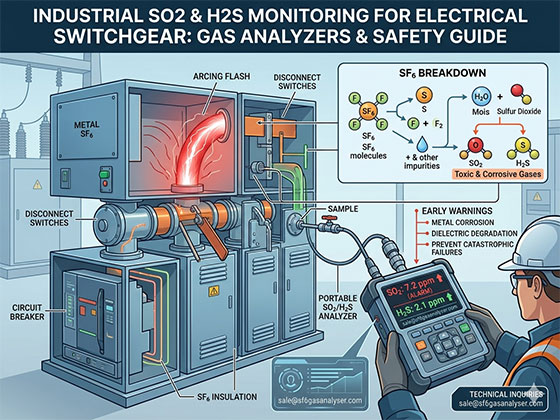
Implementing reliable industrial SO2 and H2S monitoring for electrical switchgear is the most effective way to detect internal partial discharge, prevent insulation breakdown, and avoid catastrophic grid failures. When SF6 insulation gas degrades under electrical stress, it forms highly corrosive Sulfur Dioxide (SO2) and Hydrogen Sulfide (H2S) byproducts that attack internal switchgear components. This comprehensive technical guide highlights the critical importance of sub-ppm gas analysis, showcases essential equipment specifications, outlines real-world application scenarios, and provides a B2B buying framework to maximize substation asset reliability.
If you are looking to upgrade your substation safety protocols or require a custom equipment quotation, reach out to our engineering team at [email protected] for a detailed technical consultation.
Inside high-voltage Gas Insulated Switchgear (GIS), SF6 gas serves as an exceptional thermal and electrical insulator. However, when abnormal thermal or electrical stress occurs—such as partial discharge, localized overheating, or severe electrical arcing—the SF6 molecules break down.
In the presence of trace moisture or oxygen impurities, these broken molecules recombine into highly toxic and acidic decomposition gases. This makes industrial SO2 and H2S monitoring for electrical switchgear a vital predictive maintenance practice.
Severe Metal Corrosion: SO2 and H2S combine with trace moisture to form sulfurous and sulfuric acids. These acids aggressively corrode aluminum enclosures, copper contacts, and mechanical linkages.
Loss of Dielectric Strength: The accumulation of these dynamic impurities significantly degrades the insulation capacity of the remaining SF6 gas, multiplying the risk of internal flashovers.
Asset Lifecycle Reduction: Undetected gas degradation accelerates the aging of internal solid insulation materials, leading to premature equipment replacement.
By utilizing high-precision SF6 breakdown byproduct detection equipment, field engineers can diagnose internal structural deterioration without opening the gas compartment, saving hundreds of hours in forced downtime.
To reliably execute industrial SO2 and H2S monitoring for electrical switchgear, field testing tools must overcome complex electromagnetic interference (EMI) and deliver highly repeatable data.
Advanced portable SO2 and H2S gas analyzers leverage target-specific electrochemical sensors. These sensors are integrated with cross-sensitivity software algorithms, ensuring that high concentrations of background SF6 or secondary trace gases do not distort the SO2 and H2S ppm readings.
Environmental regulations strictly control SF6 handling. High-quality substation predictive maintenance instruments utilize an internal, closed-loop gas recirculation pump. Once the measurement sample is processed, the gas is safely pumped back into the switchgear chamber or collected in an isolated internal storage cylinder, achieving zero ambient emissions.
Engineered with highly optimized internal plumbing, these monitors require a minute sample volume (less than 200 mL). The system provides stable, T90-compliant readings in under 60 seconds, drastically speeding up multi-bay inspection routines.
| Parameter | Specifications & Standards |
| Primary Target Gases | SO2 (Sulfur Dioxide), H2S (Hydrogen Sulfide) |
| SO2 Measuring Range | 0 to 100 ppm (High-range options up to 500 ppm available) |
| H2S Measuring Range | 0 to 100 ppm |
| Sensor Resolution | 0.1 ppm |
| System Measurement Accuracy | ±0.5 ppm or ±5% of total reading |
| Response Time (T90) | Less than 60 seconds |
| Required Sample Flow Rate | 200 to 500 mL/min |
| Operating Temperature Range | -20°C to +50°C (Built-in temperature compensation) |
| Digital Data Outputs | RS485 (Modbus-RTU protocol), USB flash drive export |
Asset management teams use portable sensors during scheduled annual inspections. Keeping a historical log of SO2 and H2S trends makes it easy to identify slow-developing insulation faults before they trigger an automated substation trip.
When an online circuit breaker trips, immediate industrial SO2 and H2S monitoring for electrical switchgear determines if the trip was a mechanical anomaly or an intense internal electrical arc. High concentrations of SO2 confirm an active internal fault, warning technicians not to re-energize the circuit blindly.
Before newly installed switchgear is energized, on-site SF6 gas quality verification is performed to confirm that no latent chemical contamination or moisture ingress occurred during transportation and gassing phases.
When procuring asset-protection hardware for critical energy infrastructure, prioritize the following features:
Sensor Shielding and Lifespan: Confirm that the electrochemical sensors include specialized acid-resistant filters to prevent rapid sensor degradation and calibration drift.
Form Factor Versatility: For diverse, far-flung asset fleets, a rugged, battery-powered portable SO2 and H2S gas analyzer housed in an IP67-rated case offers the best mobility. For high-priority transmission hubs, permanently installed online monitors provide continuous data streaming.
Automated Field Calibration: Look for systems that feature automated fresh-air zeroing before every test run, minimizing the need to carry heavy calibration gas cylinders into remote substation locations.
Standardization Compliance: Ensure the design and extraction methods align with the strict parameters outlined in the IEC 62271-4 guidelines for handling and analyzing SF6 gas mixtures.
In standard operating environments, SO2 levels below 1 ppm indicate a healthy system. Readings between 1 and 5 ppm point to minor, early-stage partial discharge or localized overheating, requiring increased monitoring. Any concentration exceeding 5 to 10 ppm signals serious internal arcing or intense thermal decomposition, demanding immediate equipment isolation.
The formation of H2S is dependent on the specific construction materials used by the equipment manufacturer. It appears when SF6 breakdown gases react with specific organic varnishes, sealing resins, or copper sulfide impurities present on internal electrical contacts under high temperatures.
To preserve strict sub-ppm accuracy, a comprehensive laboratory calibration with certified reference gas is recommended every 12 months. However, the system’s integrated software performs a local zero-point correction before each test to eliminate background drift caused by shifting outdoor temperatures or humidity.
Continuous or periodic industrial SO2 and H2S monitoring for electrical switchgear provides the precise chemical intelligence required to secure modern power distribution hubs. Identifying structural and gas breakdown at a molecular level empowers operators to schedule targeted repairs, drop maintenance costs, and completely eliminate catastrophic equipment blowouts.
📧 Technical Inquiry & Support
Need a formal quote, custom measurement ranges, or technical specifications for a pending substation project? Contact our specialized application engineers directly at [email protected] for swift technical support and detailed product catalogs.