
2026-02-27
If you have any needs regarding SF6 gas recovery, purification, and recycling, please feel free to contact us using the information below! We offer high-quality, standardized SF6 gas processing equipment that ensures the purity of recycled SF6 gas and helps you save on the cost of purchasing new gas.
| Phone Number: | +86-0371-68988008 |
|---|---|
| Email: | [email protected] |
| Address: | High-new Tech Zone Zhengzhou, Henan, China |
In the modern rail transit architecture, the stability of the traction power supply system is the lifeline of high-speed and urban railway operations. As the core component of power systems, Gas Insulated Switchgear (GIS) is widely utilized in railway traction substations due to its compact structure, flexible configuration, and high reliability. However, under the long-term effects of high voltage, electric arcs, and thermal stress, internal insulation degradation or latent faults within the GIS are inevitable.
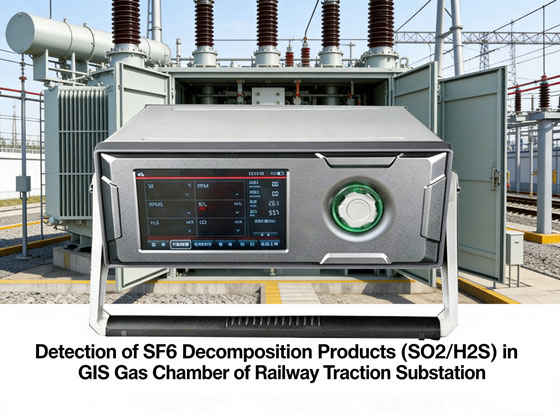
The Detection of SF6 Decomposition Products (SO2/H2S) in GIS Gas Chamber of Railway Traction Substation has emerged as one of the most sensitive and effective methods for diagnosing internal latent faults. By utilizing high-precision equipment such as the RA912F SF6 Gas Analyzer, maintenance personnel can achieve precise control over the health status of the equipment.
Sulfur Hexafluoride (SF6) gas is the preferred medium for GIS equipment due to its exceptional insulation and arc-quenching performance. In its normal physical state, SF6 is extremely stable. However, when local defects—such as partial discharge (PD), spark discharge, or local overheating—occur within the GIS gas chamber, the SF6 molecules decompose.
When SF6 gas reacts with trace amounts of moisture and oxygen in a discharge environment, it generates a series of corrosive and toxic decomposition byproducts:
Sulfur Dioxide (SO2): Primarily generated by SF6 decomposition caused by high-energy discharge or severe overheating.
Hydrogen Sulfide (H2S): Typically indicates discharge reactions involving solid insulating materials (such as insulating rods or basin insulators) or metallic components.
Railway traction substations often face violent load fluctuations caused by frequent locomotive starts, as well as continuous vibrations from rail traffic. These factors can accelerate the mechanical wear and insulation aging of internal GIS components. Therefore, regular Detection of SF6 Decomposition Products (SO2/H2S) in GIS Gas Chamber of Railway Traction Substation is crucial for preventing large-scale railway power outages.
Specifically designed for the complex environments and short maintenance windows of railway substations, the RA912F SF6 Gas Analyzer demonstrates exceptional professional adaptability.
Based on equipment specifications, the RA912F SF6 Gas Analyzer achieves top-tier industrial precision in detecting SO2 and H2S:
SO2 Detection: Utilizes electrochemical principles with a range of 0 to 100 uL/L. In the low concentration range of 0 to 10 uL/L, the error is only 0.5 uL/L, allowing it to capture weak signals during the early stages of a fault.
H2S Detection: Also based on electrochemical sensors with a range of 0 to 100 uL/L. Precise low-range detection capability provides effective early warnings for solid insulation damage.
Simultaneous Multi-Parameter Detection: The device integrates SF6 purity (thermal conductivity), moisture/dew point (capacitive principle), and carbon monoxide (CO) detection, completing a comprehensive gas chamber health assessment in a single session.
The RA912F SF6 Gas Analyzer features a built-in intelligent diagnostic engine compliant with power industry standards. It does not merely display current SO2 and H2S concentration values; it automatically compares them against standard thresholds and generates evaluation reports. For railway maintenance personnel, this “one-touch” decision support significantly improves on-site inspection efficiency.
When conducting Detection of SF6 Decomposition Products (SO2/H2S) in GIS Gas Chamber of Railway Traction Substation, technicians must infer the type of internal fault through the concentration and production rate of the components.
If test results show a significant increase in SO2 concentration while H2S remains extremely low or undetected, it usually points to overheating caused by poor contact of metal contacts or pure discharge in the gas gap.
If both SO2 and H2S concentrations increase rapidly and are accompanied by the production of CO, it indicates that the fault has affected the insulating components. In a railway GIS, this often means surface tracking or breakdown of insulators, necessitating an immediate power-off application to prevent the escalation of the accident.
To ensure the rigor and professionalism of the detection results, on-site operations should strictly follow these steps:
Pipeline Purification: Before connecting the tester, the sampling pipeline must be thoroughly purged to prevent environmental humidity or residual gas from contaminating the sample. The RA912F includes a humidity protection mechanism to minimize damage to sensors caused by improper operation.
Automatic Flow Control: Utilizing the automatic flow regulation function of the RA912F SF6 Gas Analyzer ensures a constant flow rate of approximately 0.5 L/min regardless of gas chamber pressure. This is key to maintaining the stability of the electrochemical sensors.
Data Traceability: The RA912F SF6 Gas Analyzer supports automatic ID recognition. In substations with numerous equipment units, binding test results via ID allows for the establishment of a “health file” for each GIS, enabling big data analysis of long-term decomposition trends.
With increasing requirements from railway authorities and power corporations for equipment condition monitoring, testing equipment that complies with IEC and national industry standards (such as DL/T specifications) has become mandatory.
The RA912F SF6 Gas Analyzer not only achieves high-precision measurement in hardware but also realizes seamless integration with mainstream management platforms in terms of software output. Its automatically generated inspection reports comply with the standardized work processes of railway power supply sections.
In the future, the Detection of SF6 Decomposition Products (SO2/H2S) in GIS Gas Chamber of Railway Traction Substation will move toward greater intelligence, portability, and integration. Integrated 8-in-1 analytical devices like the RA912F are the core tools for transitioning from “scheduled maintenance” to “condition-based maintenance.”
In summary, strengthening the Detection of SF6 Decomposition Products (SO2/H2S) in GIS Gas Chamber of Railway Traction Substation is a critical link in ensuring the power supply safety of the railway artery. Choosing professional equipment like the RA912F, which combines high-precision sensors with intelligent diagnostic systems, not only enables the rapid discovery of latent faults but also provides a scientific basis for precise maintenance.
Under the maintenance philosophy of “Safety First, Prevention Foremost,” digital and intelligent SF6 gas analysis technology will continue to safeguard the rapid development of rail transit.