
2026-07-15
If you have any needs regarding SF6 gas recovery, purification, and recycling, please feel free to contact us using the information below! We offer high-quality, standardized SF6 gas processing equipment that ensures the purity of recycled SF6 gas and helps you save on the cost of purchasing new gas.
| Phone Number: | +86-0371-68988008 |
|---|---|
| Email: | [email protected] |
| Address: | High-new Tech Zone Zhengzhou, Henan, China |
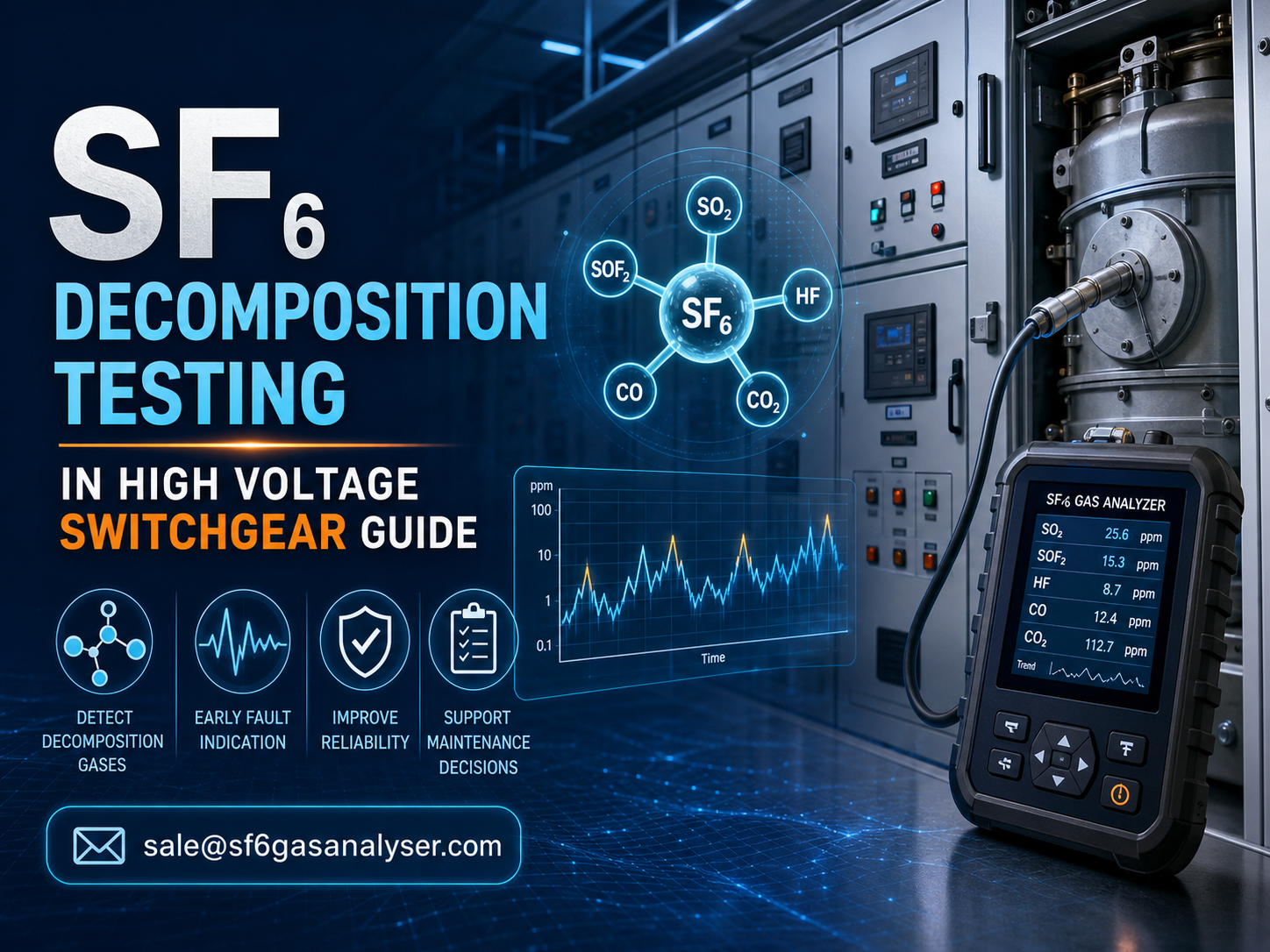
SF6 decomposition testing in high voltage switchgear is a critical diagnostic method used to evaluate the internal insulation condition, detect early discharge faults, and support safe operation of gas-insulated electrical equipment. Sulfur hexafluoride (SF6) is widely used in GIS, circuit breakers, load switches, and high voltage switchgear because of its excellent dielectric strength and arc-quenching performance. However, under electrical stress, partial discharge, overheating, or arcing, SF6 can decompose and generate by-products such as SO2, H2S, HF, CO, and CF4. Measuring these decomposition components helps maintenance teams identify hidden faults before they develop into major failures.
For utilities, power plants, substations, rail transit systems, and industrial facilities, reliable SF6 decomposition analysis is more than a routine test—it is an important part of condition-based maintenance, asset integrity management, and compliance with international electrical safety practices.
High voltage switchgear operates under demanding electrical and environmental conditions. Even when equipment appears normal externally, internal defects may gradually develop due to insulation aging, contact overheating, moisture ingress, metallic particles, or improper gas handling.
SF6 decomposition testing in high voltage switchgear provides valuable evidence for fault diagnosis by detecting abnormal gas by-products. For example, elevated SO2 may indicate discharge activity or arc-related decomposition, while increased H2S can suggest more severe insulation or contact degradation. When combined with SF6 purity, moisture, and pressure measurements, decomposition testing gives engineers a more complete picture of equipment health.
Key benefits include:
A high-quality SF6 decomposition analyzer is designed for field use in high voltage environments and must deliver accurate, repeatable, and fast measurement results. For industrial users, the value of the instrument lies not only in detection accuracy but also in operational safety, gas recovery capability, data traceability, and ease of use.
Modern analyzers can detect multiple SF6 decomposition products, including SO2, H2S, CO, HF, and sometimes CF4 or other characteristic gases. Electrochemical sensors, infrared detection, and advanced sampling systems are commonly used depending on measurement requirements.
Professional instruments are typically portable, rugged, and suitable for outdoor substation environments. Features such as anti-interference design, automatic calibration prompts, temperature compensation, and touchscreen operation improve usability in field testing.
Because SF6 is a greenhouse gas regulated in many regions, responsible testing equipment should minimize emissions. Many analyzers include gas recovery or closed-loop sampling functions to ensure the tested gas can be returned to the equipment or collected safely.
For utilities and industrial maintenance departments, historical data is essential. Test reports, time stamps, equipment identification, and digital export functions help support maintenance records, audit requirements, and long-term trend analysis.
For tailored recommendations on choosing an analyzer for SF6 decomposition testing in high voltage switchgear, users can request a free technical consultation at [email protected].
The following technical parameters represent typical specifications for a professional SF6 decomposition testing instrument used in high voltage switchgear maintenance. Actual configurations may vary depending on application needs.
| Parameter | Typical Specification |
|---|---|
| Test Gas | SF6 and SF6 decomposition products |
| Detectable Components | SO2, H2S, CO, HF, optional CF4 and moisture |
| SO2 Measurement Range | 0–100 ppm / 0–500 ppm optional |
| H2S Measurement Range | 0–100 ppm |
| CO Measurement Range | 0–500 ppm / 0–1000 ppm optional |
| HF Measurement Range | 0–10 ppm / 0–50 ppm optional |
| Detection Principle | Electrochemical sensor / infrared optional |
| Accuracy | Typically ±2% FS or better depending on sensor |
| Response Time | Usually ≤60 seconds |
| Sampling Method | Pump suction or pressure-assisted sampling |
| Gas Recovery | Optional closed-loop recovery system |
| Display | LCD or touchscreen interface |
| Data Storage | Built-in memory with USB or wireless export |
| Power Supply | Rechargeable lithium battery / AC adapter |
| Operating Temperature | -10°C to +50°C typical |
| Relative Humidity | ≤90% RH, non-condensing |
| Application Equipment | GIS, GCB, high voltage switchgear, SF6 insulated equipment |
| Compliance Reference | IEC 60480, IEC 62271 series, IEEE maintenance practices |
SF6 decomposition testing is commonly performed during scheduled inspection of GIS bays, circuit breakers, ring main units, and high voltage switchgear. Routine testing helps maintenance teams evaluate whether SF6 gas remains suitable for service and whether internal electrical activity is occurring.
When a circuit breaker trips unexpectedly or when abnormal alarms appear, decomposition analysis can help identify whether internal arcing, overheating, or insulation failure occurred. This allows engineers to make informed decisions before re-energizing equipment.
During installation or after major overhaul, SF6 gas quality verification is important. Testing decomposition products, moisture, and purity helps confirm that the equipment has been properly assembled, evacuated, filled, and sealed.
Many power utilities are shifting from time-based maintenance to condition-based maintenance. SF6 decomposition testing in high voltage switchgear supports this strategy by providing measurable data for equipment health assessment and maintenance prioritization.
Steel plants, petrochemical facilities, mining operations, data centers, and rail transit systems depend on uninterrupted power supply. SF6 decomposition testing helps these facilities reduce downtime risks and improve electrical safety management.
For substations or industrial sites requiring customized on-site testing solutions, engineering support is available through [email protected].
Testing should be carried out by trained personnel following the equipment manufacturer’s operating procedures and applicable safety regulations. Before testing, verify that the switchgear sampling port, gas pressure, hose connections, and analyzer status are suitable for operation.
SF6 itself is non-flammable and chemically stable under normal conditions, but decomposition products can be toxic and corrosive. Personnel should avoid direct inhalation of gas, use appropriate personal protective equipment, and ensure proper ventilation when working around gas compartments. Any gas containing high concentrations of decomposition products should be handled according to local environmental and occupational safety requirements.
Selecting the right instrument depends on the type of switchgear, testing frequency, required gas components, accuracy level, and reporting requirements.
For general high voltage switchgear diagnostics, SO2 and H2S are commonly selected indicators. For advanced fault analysis, CO, HF, moisture, and SF6 purity measurement may also be required.
Industrial users should choose analyzers with stable sensors, low drift, automatic temperature compensation, and reliable calibration support. Measurement accuracy directly affects diagnostic confidence.
If your organization follows strict greenhouse gas management policies, an analyzer with SF6 recovery or closed-loop sampling is strongly recommended. This supports environmental compliance and reduces gas loss.
For substation maintenance teams, the analyzer should be lightweight, durable, battery-powered, and easy to operate with gloves. Clear menus and automatic report generation reduce training time and human error.
Long-term reliability depends on calibration, sensor replacement, software updates, and technical support. Choose a supplier that understands high voltage switchgear applications and can provide professional guidance.
For one-on-one selection guidance from engineers, contact [email protected] to match the instrument configuration with your operating environment.
It is a diagnostic test that measures chemical by-products generated when SF6 gas decomposes under partial discharge, overheating, or arcing. The results help evaluate internal insulation and fault conditions.
SO2 and H2S are widely used as key indicators. Depending on the fault type and diagnostic requirements, CO, HF, CF4, moisture, and SF6 purity may also be measured.
Testing frequency depends on equipment criticality, manufacturer recommendations, utility standards, and operating history. Many operators perform testing during routine maintenance, after abnormal trips, and before or after major repairs.
It cannot eliminate all risks, but it can identify early warning signs and help maintenance teams take corrective action before defects become serious failures.
Some decomposition products, such as HF and SO2, can be corrosive or toxic. Testing must follow safe operating procedures, proper ventilation, and gas handling requirements.
SF6 decomposition testing in high voltage switchgear is an essential practice for modern electrical asset management. By identifying decomposition by-products caused by discharge, overheating, or arcing, maintenance teams can improve fault diagnosis, enhance operational safety, and extend the service life of valuable high voltage equipment. Choosing a reliable SF6 decomposition analyzer with accurate detection, field durability, data traceability, and environmentally responsible gas handling is a smart investment for utilities and industrial power users seeking safer and more efficient switchgear maintenance.