
2025-12-12
If you have any needs regarding SF6 gas recovery, purification, and recycling, please feel free to contact us using the information below! We offer high-quality, standardized SF6 gas processing equipment that ensures the purity of recycled SF6 gas and helps you save on the cost of purchasing new gas.
| Phone Number: | +86-0371-68988008 |
|---|---|
| Email: | [email protected] |
| Address: | High-new Tech Zone Zhengzhou, Henan, China |
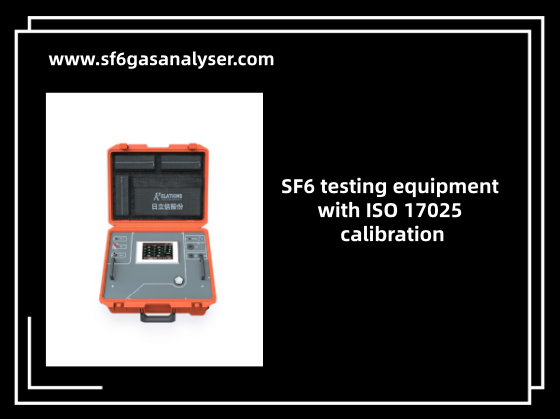
In the high-voltage power sector—where precision directly impacts safety, asset longevity, and environmental compliance—the quality of your diagnostic tools cannot be overstated. Nowhere is this truer than in the handling of sulfur hexafluoride (SF6), a potent greenhouse gas used extensively in gas-insulated switchgear (GIS), circuit breakers, and substations. As global regulations tighten under frameworks like the EU F-Gas Regulation, U.S. EPA GHG Reporting Rule, and UAE Net Zero 2050 Strategy, SF6 testing equipment with ISO 17025 calibration has become the gold standard for credible, defensible, and legally compliant gas analysis.
This article explains why ISO/IEC 17025 accreditation matters, how it elevates the reliability of SF6 measurements, and why utilities, EPC contractors, and industrial operators must insist on this certification when procuring or validating their testing instruments.
ISO/IEC 17025 is the international standard for the competence of testing and calibration laboratories. Unlike generic “factory calibration,” ISO 17025 calibration is performed by independent, accredited labs that undergo rigorous third-party audits to prove technical competence, traceability to national standards (e.g., NIST, PTB), and documented uncertainty budgets.
When applied to SF6 testing equipment, this means:
Without ISO 17025 calibration, SF6 readings—no matter how “precise” they appear—are scientifically unverifiable and legally indefensible during regulatory audits.
Many low-cost analyzers on the market claim “high accuracy” but lack accredited calibration. This creates serious operational risks:
In one 2023 incident in the GCC, a utility faced a $2M substation outage after recharging GIS with gas deemed “pure” by an uncertified handheld unit—later found to contain 4% air and elevated SO₂.
SF6 testing equipment with ISO 17025 calibration is essential in the following scenarios:
Not all calibration certificates are equal. When evaluating SF6 testing equipment with ISO 17025 calibration, verify:
✅ Accreditation Scope: The certificate must explicitly list the parameters calibrated (e.g., SF6%, H₂O ppmv, SO₂ ppm) and reference the ISO 17025 accreditation number of the lab.
✅ Traceability: Calibration gases must be traceable to NIST (USA), PTB (Germany), or equivalent NMIs (National Metrology Institutes).
✅ Uncertainty Statement: Reputable certificates include measurement uncertainty (e.g., “Moisture: ±2 ppmv at 20°C”).
✅ Validity Period: Most ISO 17025 calibrations are valid for 12 months—plan recalibration into your maintenance cycle.
✅ Regional Acceptance: In the UAE, ensure the lab or supplier is recognized by ESMA or accepted by DEWA/DoE.
Leading manufacturers provide ISO 17025 calibration as standard—and offer local recalibration services in Dubai and Abu Dhabi.
Investing in SF6 testing equipment with ISO 17025 calibration delivers measurable ROI:
For large utilities managing hundreds of GIS bays, the cost of one avoided failure can offset the price of multiple analyzers.
Modern SF6 analyzers now integrate calibration data directly into their software:
This digital traceability aligns with emerging requirements from regulators and insurers who demand full lifecycle documentation of critical measurement tools.
In an era of climate accountability and grid digitization, SF6 testing equipment with ISO 17025 calibration is no longer a “nice-to-have”—it’s a foundational requirement for any organization serious about safety, sustainability, and regulatory integrity. Whether you operate in the UAE, Europe, or North America, insisting on accredited calibration protects your assets, your reputation, and the environment.
When procuring SF6 analyzers, never accept vague claims of “accuracy.” Demand the certificate. Verify the accreditation. Choose confidence over convenience.
Because when it comes to SF6, there’s no room for guesswork.