
2026-03-25
If you have any needs regarding SF6 gas recovery, purification, and recycling, please feel free to contact us using the information below! We offer high-quality, standardized SF6 gas processing equipment that ensures the purity of recycled SF6 gas and helps you save on the cost of purchasing new gas.
| Phone Number: | +86-0371-68988008 |
|---|---|
| Email: | [email protected] |
| Address: | High-new Tech Zone Zhengzhou, Henan, China |
In the modern power industry, Gas-Insulated Switchgear (GIS) and high-voltage circuit breakers are the backbones of grid stability. The insulating medium of choice, Sulfur Hexafluoride (SF6), is prized for its exceptional dielectric strength and arc-quenching capabilities. However, the integrity of this “miracle gas” is not static. Over time, moisture infiltration and internal arcing can degrade its performance, leading to catastrophic equipment failure.
Adhering to rigorous SF6 gas quality standards for high-voltage equipment maintenance is not merely a regulatory hurdle—it is a critical safety protocol. To manage these standards effectively, the industry is shifting toward integrated, zero-emission diagnostic tools that combine purity, humidity, and decomposition product analysis.
The performance of high-voltage equipment is directly proportional to the chemical purity of the SF6 gas within. When the gas is pure, it can extinguish high-energy arcs within milliseconds. However, the presence of contaminants introduces two primary risks:
Reduced Dielectric Strength: Moisture (humidity) significantly lowers the breakdown voltage of the gas.
Corrosive Byproducts: Arcing in the presence of impurities produces toxic decomposition products like SO2 and H2S, which corrode internal silver-plated contacts and solid insulators.
Under the high temperatures of an electrical arc, SF6 dissociates. While it mostly recombines, the presence of water (H2O) or Oxygen (O2) triggers secondary reactions:
SF6 + H2O → SOF2 + 2HF
2SOF2 + H2O → SO2 + 2HF
These chemical markers—specifically SO2, H2S, and CO—are the “blood tests” of a high-voltage asset. Monitoring them is the cornerstone of proactive maintenance.
To ensure compliance with global standards (such as IEC 60480 or GB/T 12022), maintenance teams must track several key parameters.
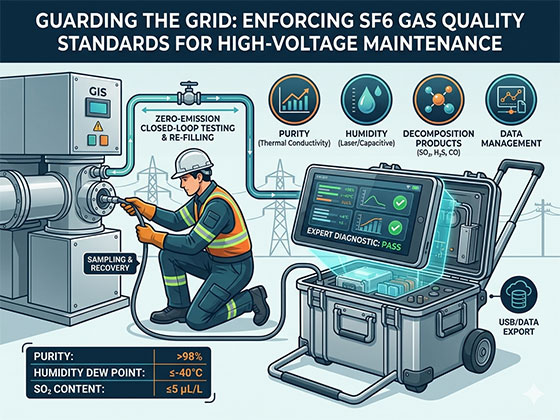
New gas typically boasts a purity of >99.9%. For equipment in operation, the standard usually dictates a minimum purity level (often >97% or >98% depending on the jurisdiction). A drop in purity suggests air ingress or significant decomposition.
Moisture is the most common “silent killer” in GIS systems.
Laser Sensing: Provides rapid response (≤30s) and high precision, unaffected by sensor “drift.”
Standards: Typically measured as a dew point. For circuit breakers, a common threshold is ≤-35°C or ≤-40°C.
The presence of SO2 and H2S indicates active internal discharging or overheating.
SO2: Thresholds are often set as low as 1μL/L to 5μL/L for “healthy” equipment.
CO: Usually indicates the involvement of organic insulation materials (like spacers) in a fault.
Traditional gas testing often involved venting small amounts of SF6 into the atmosphere—a practice now strictly discouraged due to SF6’s status as a potent greenhouse gas (Global Warming Potential ≈ 23,500).
The latest generation of Comprehensive SF6 Gas Analyzers has revolutionized this process by integrating detection with recovery and re-filling capabilities.
Closed-Loop Testing: Instead of exhausting the sample gas, the device pumps it back into the equipment or an external storage cylinder.
Expert Diagnostic Systems: These tools don’t just provide numbers; they compare data against pre-loaded SF6 gas quality standards for high-voltage equipment maintenance, offering an immediate “Pass/Fail” verdict.
Modular Maintenance: Advanced designs allow for the individual calibration or replacement of the SO2 or CO sensors without decommissioning the entire unit.
For utility managers and maintenance engineers, selecting the right hardware is vital. Based on current industry benchmarks, a high-performance analyzer should meet or exceed the following technical parameters:
| Parameter | Specification Requirement | Maintenance Significance |
| Input Pressure | 0.4 ~ 2.0 MPa | Supports high-pressure GIS environments. |
| Purity Accuracy | ±0.5% | Essential for detecting air contamination. |
| SO2/H2S Range | 0 ~ 100 μL/L | Detects early-stage partial discharge. |
| Data Storage | ≥10,000 records | Vital for trend analysis and audit trails. |
| Recovery Pressure | ≤0.8 MPa | Enables direct re-filling to the gas compartment. |
To uphold the highest SF6 gas quality standards for high-voltage equipment maintenance, O&M (Operations and Maintenance) departments should implement the following:
Standardized Sampling: Always use stainless steel or PTFE-lined hoses. Standard rubber hoses can outgas moisture, leading to false-positive humidity readings.
Trend Monitoring: A single “good” reading is less valuable than a five-year trend. A sudden rise in SO2 from 0.2μL/L to 1.5μL/L, even if still within “legal” limits, may signal an emerging fault.
Zero-Emission Policy: Utilize analyzers with internal compressors. The ability to “re-fill” directly to the sample chamber ensures that gas pressure remains stable and environmental impact is zero.
The integration of laser-based moisture detection and electrochemical decomposition analysis into a single, portable “pull-rod box” design has lowered the barrier to high-quality maintenance. By adhering to strict SF6 gas quality standards for high-voltage equipment maintenance, power companies can extend the life of their assets by decades, prevent catastrophic explosions, and fulfill their environmental responsibilities.
Professional maintenance is no longer just about fixing what is broken—it is about using precision chemistry and zero-loss technology to ensure the grid never fails in the first place.