
2026-03-04
If you have any needs regarding SF6 gas recovery, purification, and recycling, please feel free to contact us using the information below! We offer high-quality, standardized SF6 gas processing equipment that ensures the purity of recycled SF6 gas and helps you save on the cost of purchasing new gas.
| Phone Number: | +86-0371-68988008 |
|---|---|
| Email: | [email protected] |
| Address: | High-new Tech Zone Zhengzhou, Henan, China |
Choosing the right SF6 sniffer (leak detector) for PV (Photovoltaic) inverter service is increasingly important as large-scale solar farms move toward gas-insulated DC switchgear and medium-voltage string inverters to save space and improve durability.
Unlike massive 400kV GIS bays, PV inverter compartments are often more compact, vibration-prone, and exposed to extreme temperature fluctuations in outdoor solar fields.
The most critical choice is the sensor technology.
Infrared (NDIR): These are the gold standard for “Smart” solar monitoring. They use infrared light to “see” the SF6 molecule. They are highly specific, don’t react to moisture or cleaning solvents, and have long lifespans (over 10 years).
Corona Discharge (Heated Diode): These are cheaper but “blindly” react to any halogen gas. In solar farms, they can give false positives caused by humidity or the outgassing of synthetic cable insulation used in the inverters.
Recommendation: Opt for an NDIR (Non-Dispersive Infrared) sensor for inverter service to avoid wasting time chasing “phantom leaks” caused by environmental interference.
PV inverters and their associated RMUs (Ring Main Units) hold much smaller volumes of gas than traditional substation gear. A small leak can deplete the insulation pressure very quickly.
Standard Sensitivity (1.0 ppm): Suitable for general checks.
High Sensitivity (0.01 to 0.1 ppm): Necessary if you are performing “quantitative” audits to ensure the inverter meets the annual leakage rate of less than 0.1% per year.
Inverter maintenance often requires reaching into tight cabinet spaces or climbing up to elevated transformer pads.
Flexible Probe: Ensure the device has a flexible gooseneck (at least 22cm). Inverters have dense wiring; you need to be able to snake the probe behind cables to reach the gas seals.
Pump-Suction Sampling: Avoid “diffusion” sensors. You want a sniffer with a built-in pump that actively “inhales” the air around a joint. This allows for much faster response times (1 to 5 seconds) while moving the probe.
Solar farms are harsh environments. Your sniffer should have:
High-Contrast Display (OLED): Standard LCDs are impossible to read in the bright glare of a solar field. OLED displays remain visible in direct sunlight.
Zero-Point Auto-Correction: Rapid temperature changes (e.g., moving from a cool van to 40 degrees Celsius solar site) can cause “drift.” A device that auto-zeros ensures accuracy without constant manual recalibration.
Rechargeable Lithium Battery: Ensure at least 8 hours of runtime. Solar sites are often remote, and you don’t want to be hunting for batteries mid-sweep.
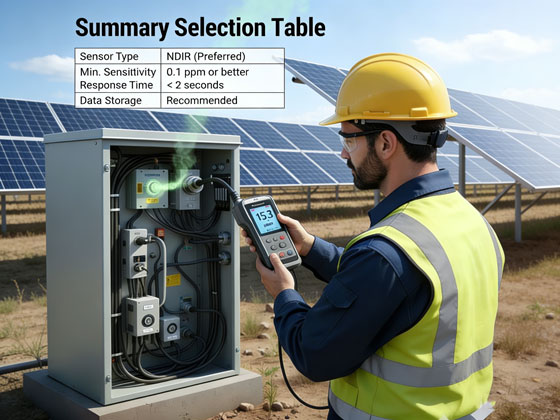
| Feature | Low-Voltage PV (String) | Medium-Voltage (Central/RMU) |
| Sensor Type | NDIR (Preferred) | NDIR (Mandatory) |
| Min. Sensitivity | 1.0 ppm | 0.1 ppm or better |
| Response Time | Less than 3 seconds | Less than 2 seconds |
| Data Storage | Optional | Recommended for compliance logs |