
2026-03-06
If you have any needs regarding SF6 gas recovery, purification, and recycling, please feel free to contact us using the information below! We offer high-quality, standardized SF6 gas processing equipment that ensures the purity of recycled SF6 gas and helps you save on the cost of purchasing new gas.
| Phone Number: | +86-0371-68988008 |
|---|---|
| Email: | [email protected] |
| Address: | High-new Tech Zone Zhengzhou, Henan, China |
For high-voltage grid operators and maintenance engineers, Sulfur Hexafluoride (SF6) is a double-edged sword. While it provides unparalleled insulation and arc-quenching capabilities for Gas-Insulated Switchgear (GIS), its status as a potent greenhouse gas makes it a target for strict global regulation.
The IEC 62271-4 standard serves as the definitive global blueprint for the “Procedures for the use and handling of Sulfur Hexafluoride.” Compliance with this standard is no longer optional; it is the cornerstone of operational safety, environmental stewardship, and regulatory risk management. This article examines how IEC 62271-4 addresses modern customer pain points and sets the technical stage for a sustainable power grid.
The primary goal of IEC 62271-4 is to minimize the release of SF6 into the atmosphere during the entire lifecycle of electrical equipment—from initial commissioning and routine maintenance to eventual decommissioning.
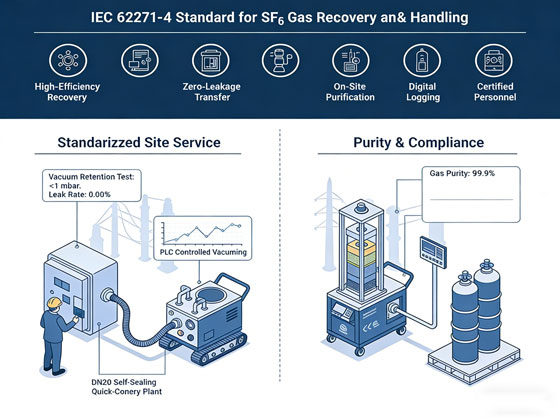
Unlike previous guidelines that were more advisory, this standard provides rigorous technical procedures for gas transfer, storage, and purification. It establishes the “zero-leakage” philosophy as the industry baseline, demanding that any gas handled must be accounted for and reclaimed with maximum efficiency.
Asset managers today face a trifecta of challenges: increasing environmental taxes on carbon emissions, the physical degradation of aging GIS assets, and a shortage of specialized labor. IEC 62271-4 directly addresses these pain points.
Many utilities struggle with “fugitive emissions”—the small puffs of gas lost during connection changes or due to inefficient recovery units.
Standardized Solution: IEC 62271-4 mandates the use of specific recovery rates (typically 99.9% or higher) and the use of self-sealing couplings.
The Impact: By using an IEC-compliant SF6 gas recovery plant, operators can prove they have reclaimed almost all gas, significantly reducing their reported carbon footprint and associated environmental fines.
Maintenance teams often worry that the gas they refill into expensive 500kV GIS might be contaminated with moisture or acidic byproducts.
Standardized Solution: The standard sets clear thresholds for “re-usable gas.” It provides the technical criteria for on-site purification, ensuring that moisture and decomposition products (SO2, HF) are removed to safe levels.
The Impact: Using compliant SF6 purification systems prevents internal corrosion of the GIS enclosure, extending the life of the asset by decades.
Without a standard, different maintenance teams might use different procedures, leading to inconsistent results and safety risks.
Standardized Solution: IEC 62271-4 provides a step-by-step framework for vacuuming, filling, and pressure testing.
The Impact: This creates a universal language for contractors and internal teams, ensuring that site services are performed correctly every time.
The standard breaks down gas handling into three distinct phases, each requiring specific equipment capabilities.
Before filling a GIS compartment with gas, it must be evacuated of air and moisture.
Requirement: The unit must reach an ultimate vacuum of less than 1 mbar.
Compliance Tip: Modern recovery units feature PLC-controlled vacuum monitoring, which can automatically perform a “Vacuum Retention Test” to ensure no leaks exist before the expensive SF6 gas is introduced.
Recovering gas from a compartment requires powerful, oil-free compressors.
Requirement: To comply with the “zero-loss” mandate, the recovery unit must be able to pull a “negative pressure” (vacuum) on the compartment being emptied.
Compliance Tip: Using an oil-free water-cooled compressor ensures the recovered gas is not contaminated by pump lubricants, making it easier to recycle.
If the recovered gas is contaminated, it must be processed.
Requirement: The standard references purity levels required for re-injection. This involves multi-stage filtration to remove solid particles (less than 1 micrometer) and moisture.
A major update in modern SF6 management is the focus on data. Under IEC 62271-4, “if it wasn’t logged, it didn’t happen.”
Asset managers are now required to maintain a “Mass Balance” log. This tracks:
Gas recovered (kg)
Gas refilled (kg)
Gas inventory in storage cylinders (kg)
Advanced SF6 gas recovery carts for high-voltage recovery now come with integrated digital scales and USB/Cloud export capabilities. This data is fed directly into ESG (Environmental, Social, and Governance) reports, providing verifiable proof of compliance during government audits.
When sourcing a CE/UL certified SF6 gas recovery plant, ensure it meets these IEC 62271-4 specific features:
| Technical Feature | IEC Requirement / Best Practice | Benefit |
| Recovery Efficiency | > 99.9% | Minimizes environmental release. |
| Filtration Precision | <= 1 micrometer | Protects delicate GIS internal parts. |
| Compression Technology | 100% Oil-Free | Ensures gas remains high-purity. |
| Vacuum Performance | < 1 mbar | Ensures moisture-free commissioning. |
| Safety Features | Anti-Suckback Valves | Prevents pump oil from entering the GIS. |
IEC 62271-4 is not just about the machine; it is about the operator. The standard emphasizes that personnel must be “competent and trained.”
This includes:
Understanding the chemical properties of SF6 and its decomposition products.
Proper handling of gas cylinders (storing them at correct temperatures and pressures).
Emergency procedures in the event of a major leak or exposure.
For service providers, having a team of “IEC-certified SF6 technicians” is a major competitive advantage when bidding for large-scale utility contracts.
While the standard is universal, its application varies by site service scenario:
The focus is on bulk volume handling. Units with 30 m3/h to 50 m3/h recovery speeds are prioritized to minimize downtime during grid outages. Compliant units must handle the high pressures (up to 50 bar) required for liquid storage in cylinders.
Here, the focus is on safety and corrosion. Industrial GIS in refineries is often exposed to corrosive ambient air. IEC 62271-4 compliance in these zones requires recovery units with enhanced chemical filtration to neutralize the acidic byproducts that form more rapidly in industrial environments.
The IEC 62271-4 standard is more than a technical manual; it is a strategic shield for your organization. By adhering to its guidelines, you protect your expensive GIS assets from moisture, your personnel from toxic byproducts, and your company from the legal and financial fallout of environmental non-compliance.
As the industry eventually transitions to “SF6-Free” alternatives, the rigorous handling cultures established by this standard will serve as the foundation for managing the next generation of insulating gases.