
2026-03-23
If you have any needs regarding SF6 gas recovery, purification, and recycling, please feel free to contact us using the information below! We offer high-quality, standardized SF6 gas processing equipment that ensures the purity of recycled SF6 gas and helps you save on the cost of purchasing new gas.
| Phone Number: | +86-0371-68988008 |
|---|---|
| Email: | [email protected] |
| Address: | High-new Tech Zone Zhengzhou, Henan, China |
In the modern power industry, Sulfur Hexafluoride (SF6) is both a technical miracle and an environmental challenge. As a potent greenhouse gas with a global warming potential (GWP) approximately 23,500 times that of CO2, its management is strictly regulated worldwide. For utility managers and substation engineers, a critical question often arises during maintenance cycles: Can SF6 gas be reused after recovery from a substation?
The short answer is yes, but with a significant caveat—it must be processed through a high-performance SF6 recovery unit that meets rigorous technical standards like DL/T 662. Reusing SF6 is not just an environmentally responsible choice; it is a cost-effective strategy that maintains the operational integrity of high-voltage assets ranging from 72.5kV to 500kV.
Pure SF6 is chemically inert and non-toxic. However, inside a circuit breaker or Gas Insulated Switchgear (GIS), the gas is subjected to high-energy electric arcs. These arcs cause the SF6 molecules to temporarily disassociate. While most molecules recombine into SF6, some react with trace moisture, oxygen, or electrode metals (like copper or aluminum) to form toxic and corrosive byproducts, such as:
Thionyl Fluoride (SOF2)
Sulfur Dioxide (SO2)
Hydrogen Fluoride (HF)
Metal Fluoride Powders (Solid Particles)
To answer “Can SF6 gas be reused?”, one must look at whether these impurities can be effectively removed.
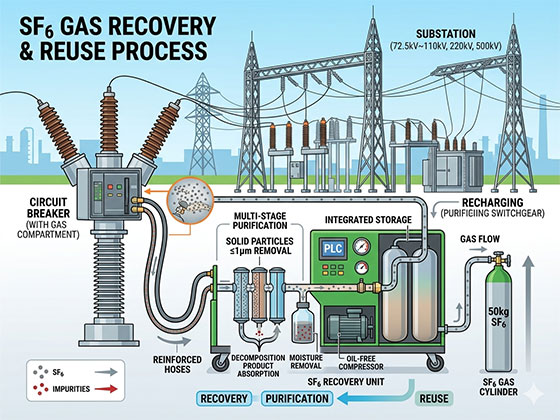
For SF6 gas to be safely returned to a 220kV porcelain column circuit breaker or a 500kV GIS system, it must be restored to a state of high purity. This requires an integrated recovery unit capable of performing “comprehensive gas treatment.”
The most vital safety feature to look for is a multi-stage filtration system. According to industrial benchmarks, a recovery unit must be able to filter:
Solid Particles: Removal of decomposition dust down to a particle size of 1 micrometer or less.
Chemical Impurities: Using activated alumina or molecular sieves to neutralize acidic decomposition products.
Moisture: Reducing water content to prevent the formation of hydrofluoric acid, which can etch internal insulators.
When recovering gas, there is a risk of introducing new contaminants. Older recovery systems often used lubricated compressors, which risked “oil carryover.” Modern, high-tier units utilize oil-free water-cooled compressors (with a typical capacity of 15 cubic meters per hour). These ensure that the gas remains free of hydrocarbons, which is a non-negotiable requirement for high-voltage insulation.
Before recharging equipment with recovered gas, the switchgear must be evacuated to remove air and moisture. A professional SF6 recovery unit features a vacuum pump with an anti-suckback valve. This prevents vacuum pump oil from entering the gas compartment—a common failure point that would otherwise render the SF6 gas unfit for reuse.
To ensure SF6 can be reused effectively, the recovery equipment integrates several functions into a single, PLC-controlled system.
To maximize the “reusability” and minimize environmental impact, the unit must possess negative pressure recovery functions. This ensures that virtually all gas is extracted from the switchgear, leaving no residual contaminants behind and increasing the total volume of gas available for reuse.
Recovered gas is often stored in liquid form to save space. High-efficiency units can fill a 40L cylinder with 50kg of SF6 in just 5 to 8 minutes. During this phase, auxiliary cooling (water-cooled or air-cooled depending on regional ambient temperatures) ensures the gas reaches its output final pressure (e.g., 50 bar) safely.
“Can SF6 gas be reused” also depends on the recharging method. If gas is recharged too quickly or at the wrong temperature, it may liquefy inside the equipment. A unit equipped with a 1.5kW vaporizer and an independent gas heating system ensures the SF6 is returned to the switchgear at the correct pressure (usually adjustable between 1–10 bar) and in a purely gaseous state.
The decision to reuse SF6 gas after recovery provides three distinct advantages for power utilities:
| Benefit Category | Impact |
| Environmental | Prevents the release of greenhouse gases; reduces the need for new gas production. |
| Financial | New SF6 gas is expensive; recovery and purification cost a fraction of purchasing fresh gas. |
| Logistical | Minimizes the need for transporting hazardous gas cylinders to and from remote substations. |
Equipment designed and manufactured according to the DL/T 662 standard provides the reliability needed for these high-stakes operations. These units feature modular designs for easy maintenance and semi-enclosed structures that protect sensitive PLC electronics from the harsh environment of an outdoor substation.
So, can SF6 gas be reused after recovery from a substation? Absolutely. With the right SF6 recovery unit—one that offers precision filtration, oil-free compression, and real-time vacuum monitoring—recovered gas can meet the same performance standards as virgin gas.
By investing in high-quality, multi-functional recovery units, power companies can ensure the longevity of their 72.5kV–500kV equipment while fulfilling their commitment to environmental sustainability.