
2026-07-20
If you have any needs regarding SF6 gas recovery, purification, and recycling, please feel free to contact us using the information below! We offer high-quality, standardized SF6 gas processing equipment that ensures the purity of recycled SF6 gas and helps you save on the cost of purchasing new gas.
| Phone Number: | +86-0371-68988008 |
|---|---|
| Email: | [email protected] |
| Address: | High-new Tech Zone Zhengzhou, Henan, China |
Sulfur hexafluoride (SF6) is widely used in gas-insulated switchgear (GIS), circuit breakers, and high-voltage electrical equipment due to its excellent dielectric strength and arc-quenching performance. However, after service, SF6 may contain moisture, air, decomposition products, oil vapor, and particulate contaminants that affect safety and insulation reliability. For asset managers, maintenance engineers, and gas recovery teams, understanding what are the key impurities that prevent SF6 gas reuse is essential for deciding whether the gas can be reclaimed, purified, or must be handled as contaminated waste in accordance with environmental and electrical industry requirements.
SF6 gas reuse supports sustainable power equipment maintenance by reducing greenhouse gas emissions, lowering procurement costs, and improving gas inventory management. Because SF6 has a high global warming potential, international regulations and best practices strongly encourage closed-loop handling, leak prevention, recovery, purification, and documentation.
However, reused SF6 must meet quality requirements suitable for electrical insulation and switching performance. Standards such as IEC 60480 provide guidance on the reuse of SF6 and its mixtures in electrical equipment, while IEC 60376 defines requirements for new SF6 gas. In practice, service teams rely on a high-precision sf6 analyzer to evaluate gas quality before recharging equipment. If impurity levels exceed acceptable limits, direct reuse may increase the risk of flashover, corrosion, equipment aging, or operational failure.
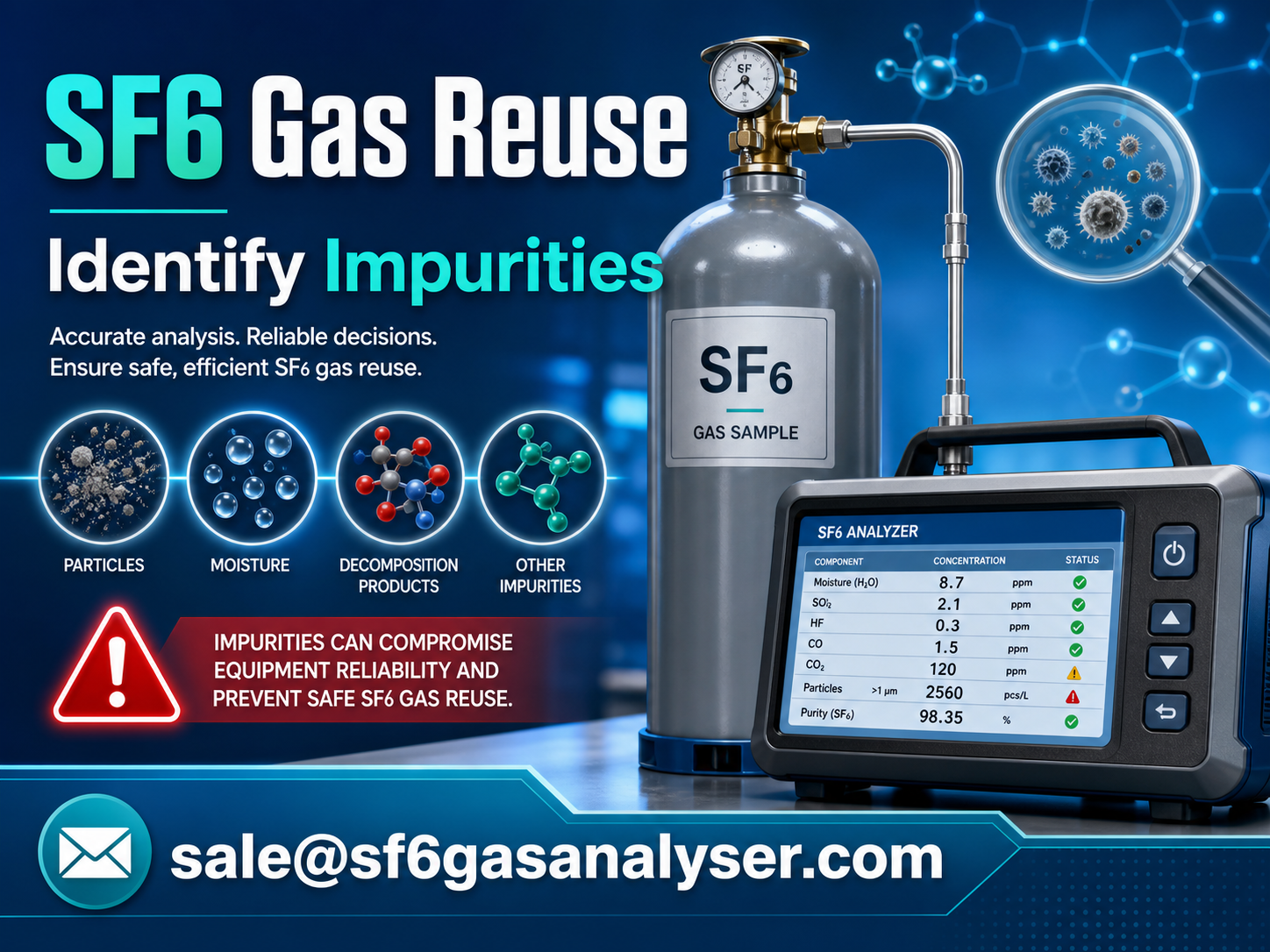
The main impurities that typically determine whether SF6 can be reused include moisture, air components, toxic decomposition by-products, mineral oil, and solid particles. Each impurity affects the gas differently, and professional testing is required before any reuse decision.
Moisture is one of the most common contaminants found in recovered SF6. It may enter through leaking seals, improper gas handling, wet hoses, poorly evacuated compartments, or inadequate storage cylinders. Excessive water content reduces dielectric strength and can react with SF6 decomposition products to form corrosive acids.
Moisture is typically measured as dew point, ppmv, or frost point. High moisture concentration can lead to internal condensation under low-temperature operating conditions, creating serious insulation risks in GIS and circuit breaker compartments. For this reason, moisture measurement is a core function of any professional sf6 analyzer used for SF6 gas reuse qualification.
Air contamination usually consists mainly of nitrogen and oxygen. It may indicate that external air has entered the equipment through leaks or that gas recovery and filling procedures were not properly controlled. While nitrogen itself is sometimes used in approved SF6 gas mixtures, uncontrolled air contamination reduces the purity of SF6 and can negatively affect dielectric performance.
Oxygen is especially important because it may contribute to oxidation reactions under electrical stress or arc conditions. In high-voltage applications, even small deviations in gas composition should be evaluated carefully against equipment manufacturer requirements and applicable standards.
When SF6 is exposed to electrical arcing, partial discharge, overheating, or internal faults, it can decompose into reactive by-products. These may include sulfur fluorides, sulfur oxyfluorides, hydrogen fluoride, sulfur dioxide, and other acidic or toxic compounds. Decomposition products are among the most important impurities that can prevent direct SF6 gas reuse.
Compounds such as SO2 are often measured as indicators of internal arcing or degradation. Acidic by-products may corrode metal components, damage seals, contaminate adsorbents, and create health hazards for maintenance personnel. If decomposition levels are high, gas should not be reused without appropriate purification, filtration, and verification testing.
Oil vapor can enter SF6 through compressors, vacuum pumps, recovery carts, lubricated valves, or contaminated cylinders. Hydrocarbon contamination can reduce gas purity and may affect insulation reliability, especially in precision high-voltage equipment. In severe cases, oil films may deposit on internal surfaces and attract dust or particles.
For gas recovery contractors and utility maintenance teams, oil-free handling systems and clean gas paths are important for maintaining reusable SF6 quality. Periodic equipment maintenance and correct filter replacement are also necessary to prevent cross-contamination.
Solid particles may include metal dust, desiccant fragments, switching residues, corrosion particles, or contamination from hoses and cylinders. Although particulate contamination is not always measured by standard portable analyzers, it can be a serious problem in GIS compartments where electric field stress is high.
Particles can create local field enhancement and increase the probability of partial discharge. During gas recovery and recycling, particle filters should be used, and cylinders should be properly inspected and cleaned according to accepted industrial procedures.
A reliable sf6 analyzer helps maintenance teams make evidence-based decisions about whether gas can be reused, purified, or rejected. Compared with visual inspection or single-parameter testing, multi-parameter analysis provides a clearer picture of gas condition.
Key advantages include:
For utilities, industrial plants, laboratories, and service contractors seeking accurate testing equipment, a technical consultation can help match the analyzer configuration to field requirements. Contact [email protected] for a free consultation on SF6 gas quality testing and reuse evaluation.
| Parameter | Typical Measurement Range | Application Purpose |
|---|---|---|
| SF6 Purity | 0–100% | Determines whether gas concentration is suitable for reuse |
| Moisture / Dew Point | -80°C to +20°C dew point | Assesses insulation risk and condensation potential |
| SO2 | 0–100 ppm or higher optional ranges | Indicates arcing, decomposition, and internal faults |
| HF | Configurable ppm range | Detects acidic and corrosive decomposition by-products |
| O2 | 0–25% | Identifies air ingress and gas handling contamination |
| CO / H2S | Configurable ppm range | Supports deeper fault and contamination analysis |
| Response Time | Typically within minutes | Enables efficient field testing and maintenance decisions |
| Data Storage | Internal memory / export options | Supports traceability, reports, and compliance documentation |
Actual specifications may vary by instrument model, sensor configuration, calibration method, and customer application. For customized on-site solutions for GIS maintenance, circuit breaker servicing, or gas recovery stations, contact [email protected] to receive application-specific recommendations.
Gas-insulated substations require stable insulation performance and long-term reliability. SF6 analysis helps verify whether gas removed during maintenance can be returned to service after filtration or purification.
Circuit breakers may generate decomposition products during switching operations. Before reuse, recovered gas should be tested for moisture, SO2, oxygen, and purity to prevent reintroducing contaminated gas into the equipment.
Professional gas recycling operations depend on accurate testing to classify recovered gas, monitor purification performance, and confirm final gas quality before redistribution.
During new equipment installation or commissioning, SF6 quality verification ensures that filling procedures meet operational standards and that no air or moisture contamination has occurred.
When selecting an sf6 analyzer for SF6 gas reuse, buyers should focus on measurement accuracy, sensor stability, calibration support, safety design, and field usability. A suitable analyzer should measure the impurities most relevant to your equipment type and maintenance process.
Consider the following purchasing factors:
For B-end industrial users managing multiple substations or service projects, one-on-one guidance from engineers can reduce procurement risk and improve testing efficiency. Email [email protected] for professional selection support based on your SF6 gas reuse workflow.
No. SF6 gas can only be reused when impurity levels meet the required quality criteria for the intended electrical equipment. Gas with excessive moisture, air, toxic decomposition products, oil, or particles must be purified, reclaimed, or handled according to safety and environmental procedures.
There is no single universal answer. Moisture is highly damaging to insulation reliability, while decomposition products such as SO2 and HF indicate chemical hazards and internal faults. The reuse decision should be based on comprehensive analysis rather than one parameter alone.
Testing frequency depends on equipment criticality, operating history, manufacturer recommendations, and local regulations. Common testing points include before filling, after recovery, during routine maintenance, after a fault, and before gas reuse.
Purification systems can remove many impurities, including moisture, particles, and some decomposition products. However, final gas quality must always be verified with a calibrated SF6 analyzer before reuse. Severely contaminated gas may require specialized treatment.
Documentation supports regulatory compliance, environmental responsibility, quality control, and asset management. Test reports provide evidence that reused SF6 meets operational requirements and that handling procedures were properly followed.
Understanding what are the key impurities that prevent SF6 gas reuse is essential for safe, compliant, and cost-effective high-voltage equipment maintenance. Moisture, air, decomposition products, oil vapor, and particulates are the primary contaminants that can compromise insulation performance, equipment integrity, and worker safety. By using a professional sf6 analyzer, maintenance teams can accurately assess recovered gas, support sustainable SF6 gas reuse, and make responsible decisions aligned with international standards and industrial best practices.