
2025-12-15
If you have any needs regarding SF6 gas recovery, purification, and recycling, please feel free to contact us using the information below! We offer high-quality, standardized SF6 gas processing equipment that ensures the purity of recycled SF6 gas and helps you save on the cost of purchasing new gas.
| Phone Number: | +86-0371-68988008 |
|---|---|
| Email: | [email protected] |
| Address: | High-new Tech Zone Zhengzhou, Henan, China |
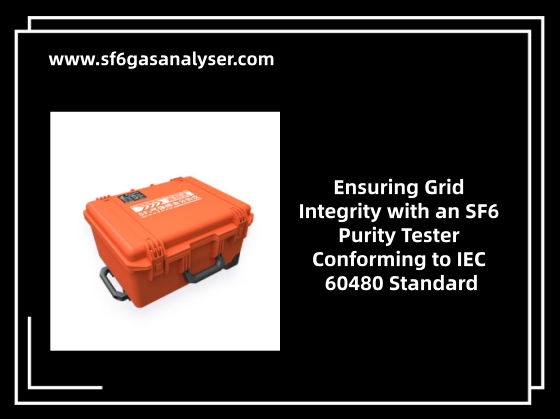
In the high-voltage power sector, where reliability and safety are paramount, sulfur hexafluoride (SF₆) remains the insulating gas of choice for gas-insulated switchgear (GIS), circuit breakers, and other critical transmission equipment. However, as global environmental regulations tighten and grid operators face increasing pressure to reduce greenhouse gas emissions, the responsible management of SF₆ has become a strategic priority. Central to this effort is the use of an SF6 purity tester conforming to IEC 60480 standard—a tool that ensures gas quality, regulatory compliance, and long-term asset performance.
SF6 offers exceptional dielectric strength and arc-quenching capabilities, making it ideal for compact, high-performance electrical systems. Yet its effectiveness hinges on chemical purity. During normal operation—or especially after fault events—SF₆ can decompose due to electrical arcing, producing hazardous byproducts such as sulfur dioxide (SO₂), hydrogen fluoride (HF), carbonyl sulfide (COS), and moisture (H₂O). Additionally, air ingress (N₂/O₂) or oil vapor contamination can further degrade performance.
Even trace impurities compromise insulation integrity, accelerate internal corrosion, and increase the risk of catastrophic failure. More critically, degraded SF₆ cannot be safely reused without verification—venting it contributes significantly to climate impact, given its global warming potential (GWP) of 23,500 over a 100-year horizon.
This is where rigorous gas quality assessment becomes non-negotiable—and why utilities worldwide rely on an SF6 purity tester conforming to IEC 60480 standard.
Published by the International Electrotechnical Commission (IEC), IEC 60480 provides guidelines for the “reuse of sulfur hexafluoride (SF₆) from electrical equipment.” It defines maximum allowable concentrations for key contaminants in recovered SF₆ before it can be safely reintroduced into equipment. Key thresholds include:
These limits ensure that reused SF₆ maintains its dielectric properties and does not introduce corrosive or conductive elements into sensitive components.
An SF₆ purity tester conforming to IEC 60480 standard is specifically engineered to measure these parameters with laboratory-grade accuracy in field conditions—enabling real-time decisions on whether gas can be reused, purified, or must be replaced.
Modern IEC 60480-compliant SF6 purity testers integrate multiple sensing technologies into a single portable unit:
Crucially, these devices feature:
Many also support closed-loop sampling—allowing gas to be tested without release into the atmosphere, aligning with EPA and EU F-Gas best practices.
Using a non-compliant or uncertified device risks false readings, leading to either unnecessary gas replacement (increasing costs) or unsafe reuse (risking equipment failure). A genuine SF₆ purity tester conforming to IEC 60480 standard must:
Grid operators in the EU, North America, and the Gulf Cooperation Council (GCC) increasingly require such certification as part of maintenance contracts and environmental compliance programs.
Deploying an IEC 60480-compliant SF6 purity tester delivers significant advantages:
A 2022 CIGRE report found that transmission system operators using IEC 60480-compliant testers reduced annual SF₆ consumption by 35% while improving GIS availability by 12%.
To maximize value and compliance:
As the global energy sector navigates the dual challenges of grid modernization and decarbonization, the intelligent management of SF₆ is more critical than ever. An SF6 purity tester conforming to IEC 60480 standard is not merely a diagnostic instrument—it is a cornerstone of responsible asset stewardship, environmental accountability, and operational excellence.
For utilities, industrial facilities, and engineering service providers, investing in certified, standards-aligned testing technology is both a technical necessity and a strategic differentiator. In an era where every kilogram of SF₆ counts, precision backed by international standards isn’t optional—it’s essential.