
2026-07-16
If you have any needs regarding SF6 gas recovery, purification, and recycling, please feel free to contact us using the information below! We offer high-quality, standardized SF6 gas processing equipment that ensures the purity of recycled SF6 gas and helps you save on the cost of purchasing new gas.
| Phone Number: | +86-0371-68988008 |
|---|---|
| Email: | [email protected] |
| Address: | High-new Tech Zone Zhengzhou, Henan, China |
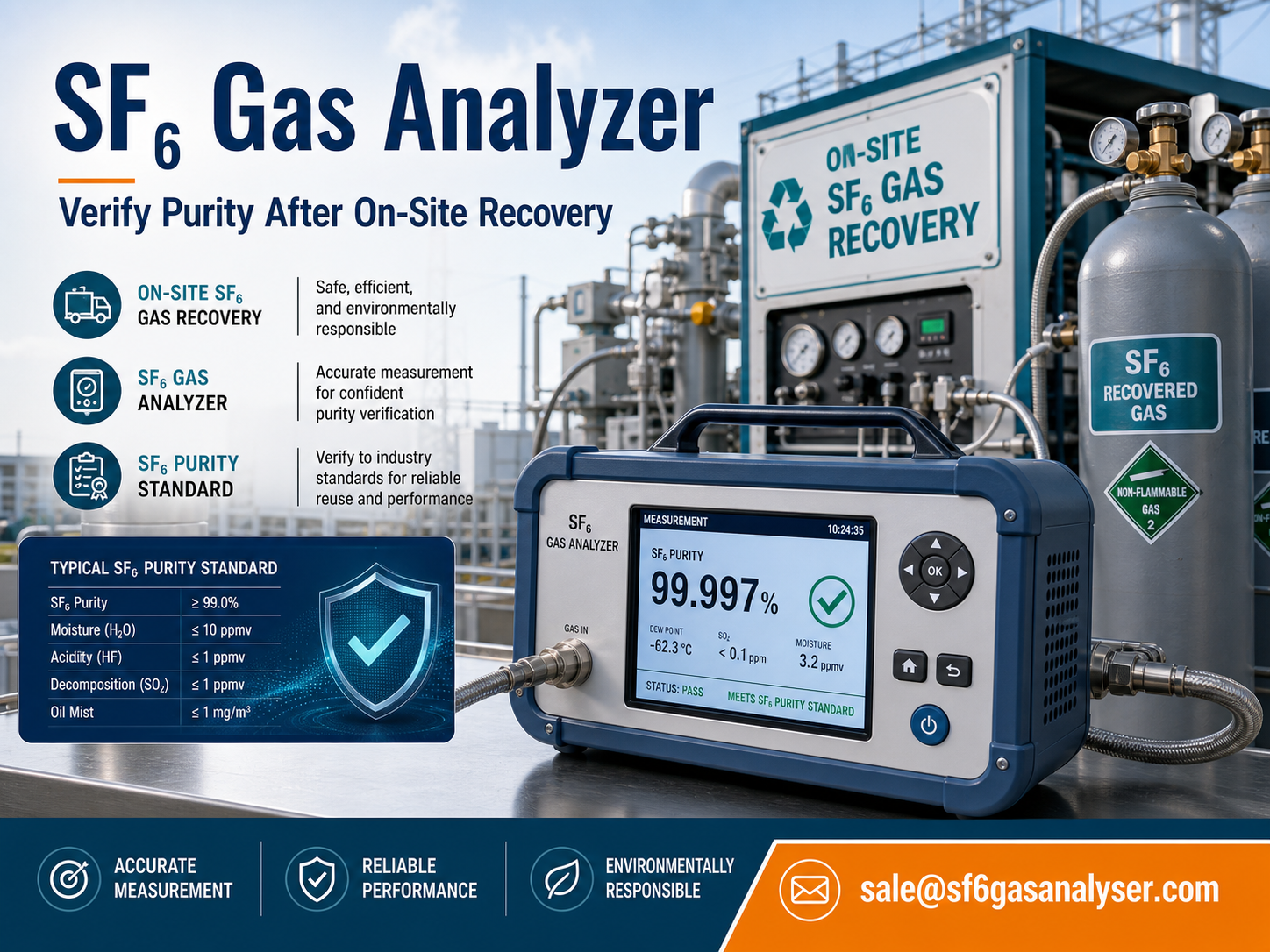
After on-site SF6 gas recovery, verifying gas quality is essential before the gas is returned to gas-insulated switchgear (GIS), circuit breakers, transformers, or other high-voltage equipment. Recovered SF6 may contain moisture, air, decomposition by-products, oil mist, or particulate contamination introduced during service or handling. To ensure safe refilling, operators must test the gas with a calibrated SF6 gas analyzer, compare results against the applicable SF6 purity standard, and confirm that moisture and contamination levels are within acceptable limits for electrical insulation and arc-quenching performance.
SF6 is widely used in high-voltage electrical equipment because of its excellent dielectric strength, thermal stability, and arc-extinguishing capability. However, once the gas has been exposed to electrical discharge, internal equipment faults, or poor handling practices, its quality can deteriorate. Even small amounts of moisture or air can reduce insulation performance, while acidic decomposition products may corrode internal components and endanger maintenance personnel.
For this reason, industrial operators should never refill recovered SF6 based only on pressure readings or visual inspection of cylinders. A systematic quality check using an accurate SF6 gas analyzer helps confirm whether the recovered gas is reusable, requires purification, or must be sent for treatment according to environmental and safety requirements.
SF6 purity indicates the percentage of sulfur hexafluoride in the recovered gas. Reduced purity usually means the gas has been diluted with air, nitrogen, CF4, or other gases. Low purity can reduce dielectric strength and increase the risk of partial discharge or insulation failure.
In many practical applications, reusable SF6 should meet the manufacturer’s equipment specifications and relevant standards such as IEC 60480 for used SF6 handling and IEC 60376 for new SF6 quality. While exact limits depend on equipment type and utility procedures, operators commonly verify that the gas meets the required SF6 purity standard before refilling high-voltage assets.
Moisture is one of the most critical parameters after on-site SF6 gas recovery. Excess water vapor may form corrosive compounds when combined with SF6 decomposition products. It can also reduce insulation reliability, especially under low-temperature operating conditions.
Moisture is typically measured in ppmv or expressed as dew point temperature. A professional analyzer should provide stable and temperature-compensated readings. Before refilling, the measured moisture level should comply with the electrical equipment manufacturer’s limit and applicable maintenance standards.
During switching operations or internal arcing, SF6 can decompose into by-products such as SO2, HF, SOF2, and other sulfur-fluorine compounds. These substances may be toxic, corrosive, and harmful to insulation materials. Measuring SO2 is a common field indicator of SF6 decomposition, while advanced analyzers may detect additional contamination gases.
If the contamination level exceeds acceptable limits, the gas should not be directly refilled. It may require filtration, drying, regeneration, or disposal through approved environmental management channels.
After recovery, allow the gas cylinder to stabilize to ambient temperature where practical. Temperature fluctuations can affect pressure and moisture readings. Ensure the cylinder is clearly labeled with source equipment, recovery date, operator name, and any suspected fault history.
Use clean, dry, SF6-compatible hoses and fittings. Avoid using contaminated tubing or connections that may introduce air or moisture into the sample path. Leak-tight connections are important for accurate purity and dew point measurement.
Before testing, confirm that the SF6 gas analyzer is within its calibration validity period. For critical assets, a bump test or zero/span verification may be required according to company procedures. Reliable measurement depends on sensor condition, flow control, and proper sampling technique.
Run the test according to the analyzer manual. Allow sufficient purge time so the sample is representative of the cylinder contents rather than residual gas in the hose. Record SF6 purity, moisture content, dew point, SO2 concentration, pressure, temperature, and test time.
Evaluate the results against IEC guidance, local environmental regulations, and the original equipment manufacturer’s requirements. If all values are within acceptable limits, the recovered SF6 may be approved for refilling. If results are borderline, retesting or purification is recommended before reuse.
A high-quality analyzer for recovered SF6 verification should integrate purity, moisture, and decomposition testing in one portable system. The following technical parameter sheet outlines common specifications for industrial field use.
| Measurement Items | SF6 purity, moisture/dew point, SO2 decomposition products, optional HF/H2S/CO |
| SF6 Purity Range | 0–100% SF6 |
| Purity Accuracy | Typically ±0.5% or better, depending on sensor configuration |
| Moisture Range | -80°C to +20°C dew point, or equivalent ppmv range |
| Moisture Accuracy | Typically ±2°C dew point |
| SO2 Range | 0–100 ppm / 0–500 ppm optional |
| Sampling Method | Internal pump or regulated flow sampling |
| Data Storage | Test records with time, date, and equipment ID |
| Output Options | USB, Bluetooth, printer, or report export depending on model |
| Power Supply | Rechargeable battery and AC adapter |
| Application | GIS substations, circuit breakers, SF6 recovery carts, gas storage cylinders |
For utilities, EPC contractors, and maintenance service companies that require analyzer selection support, a free technical consultation is available by contacting [email protected].
Instead of sending samples to a laboratory and waiting for results, a portable analyzer allows maintenance teams to determine gas usability immediately after on-site SF6 gas recovery. This reduces equipment downtime and supports faster refilling decisions.
By detecting moisture and decomposition products before refilling, operators reduce the risk of internal corrosion, insulation degradation, and personnel exposure to harmful by-products. Documented test results also support compliance with environmental reporting and asset maintenance programs.
Because SF6 is costly and subject to strict greenhouse gas management requirements, verifying recovered gas quality enables safe reuse when conditions allow. This reduces the need for new gas procurement and minimizes emissions associated with unnecessary venting or disposal.
Modern analyzers store test data and generate reports for maintenance history, audit preparation, and asset reliability analysis. This is especially valuable for power utilities managing large GIS fleets across multiple substations.
During GIS compartment maintenance, recovered gas must be analyzed before being returned to the same or another compartment. Purity, dew point, and SO2 readings help confirm whether the gas meets the required SF6 purity standard for reliable operation.
SF6 circuit breakers may produce decomposition products during arc interruption. Before refilling after overhaul, technicians should test the recovered gas to ensure by-products are not present at unsafe levels.
Gas recovery carts are widely used for evacuation, storage, filtration, and refilling. Pairing the recovery system with an SF6 gas analyzer allows operators to verify the effectiveness of filtration and drying before reuse.
For new installations, gas analysis confirms filling quality. After faults or alarms, gas testing helps identify contamination caused by internal discharge and supports safer maintenance planning.
When selecting an analyzer for recovered SF6 verification, consider the following points:
For customized on-site testing solutions for GIS fleets, substations, or SF6 service teams, contact [email protected] for engineer-guided recommendations.
Not automatically. Recovered SF6 should be tested for purity, moisture, and decomposition products before reuse. If the gas meets the applicable SF6 purity standard and equipment manufacturer’s requirements, it may be suitable for refilling.
High moisture can reduce insulation performance and promote corrosion when combined with SF6 decomposition by-products. The gas should be dried or purified before being returned to electrical equipment.
Yes, it is recommended, especially for circuit breakers and equipment with a history of operation, alarms, or suspected internal discharge. SO2 is a practical indicator of SF6 decomposition and helps assess gas condition.
Calibration intervals depend on manufacturer recommendations, usage frequency, and internal quality procedures. Many industrial users perform annual calibration, while critical applications may require more frequent verification.
Yes. Portable multi-function analyzers are designed for field use across different substations. However, operators should follow proper purging, hose cleaning, and sampling procedures to avoid cross-contamination.
Verifying SF6 quality after on-site SF6 gas recovery is a critical step for safe, compliant, and cost-effective high-voltage equipment maintenance. With a reliable SF6 gas analyzer, operators can confidently assess purity, moisture, and contamination levels before refilling, reducing operational risk and supporting responsible SF6 lifecycle management. For one-on-one guidance from application engineers, send your requirements to [email protected].