
2026-07-06
If you have any needs regarding SF6 gas recovery, purification, and recycling, please feel free to contact us using the information below! We offer high-quality, standardized SF6 gas processing equipment that ensures the purity of recycled SF6 gas and helps you save on the cost of purchasing new gas.
| Phone Number: | +86-0371-68988008 |
|---|---|
| Email: | [email protected] |
| Address: | High-new Tech Zone Zhengzhou, Henan, China |
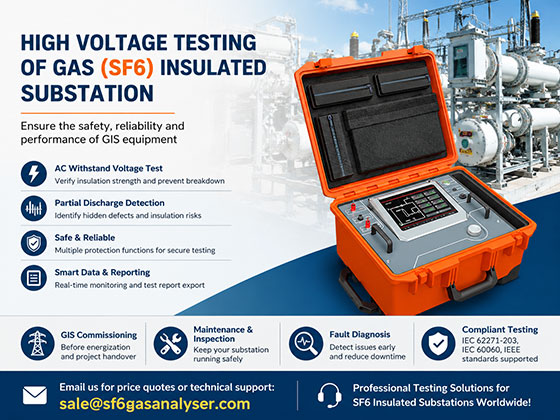
High Voltage Testing of Gas (SF6) Insulated Substation is a critical service and technical solution for verifying the insulation performance, safety, and reliability of GIS equipment before commissioning, after maintenance, or during routine inspection. For power utilities, EPC contractors, electrical testing companies, and substation maintenance teams, High Voltage Testing of Gas (SF6) Insulated Substation helps detect hidden insulation defects, reduce outage risks, improve compliance, and support stable operation of high-voltage power systems.
High Voltage Testing of Gas (SF6) Insulated Substation refers to the process of applying controlled high-voltage stress to SF6 gas insulated switchgear, GIS busbars, circuit breakers, disconnectors, grounding switches, and related substation components. The purpose is to confirm whether the equipment can safely withstand its required voltage level without flashover, insulation breakdown, or abnormal discharge.
In modern transmission and distribution networks, SF6 gas insulated substations are widely used because they offer compact structure, high insulation strength, and reliable performance. However, hidden defects such as moisture, metal particles, poor installation, gas contamination, insulation aging, and internal discharge may cause serious failures. Therefore, High Voltage Testing of Gas (SF6) Insulated Substation is essential for safe grid operation.
The working principle of High Voltage Testing of Gas (SF6) Insulated Substation is to simulate high-voltage operating conditions and evaluate the insulation response of GIS equipment. During testing, engineers gradually increase the test voltage according to the required procedure and monitor voltage, current, partial discharge signals, grounding status, and protection parameters.
A professional GIS high voltage test system can support AC withstand voltage testing, variable frequency resonant testing, partial discharge detection, and insulation performance diagnosis. By analyzing test results, operators can determine whether the SF6 insulated substation is ready for energization or requires further inspection.
The typical testing steps include:
High Voltage Testing of Gas (SF6) Insulated Substation verifies whether GIS equipment can withstand required voltage stress before operation. This is especially important for newly installed substations, GIS expansion projects, and repaired equipment.
Partial discharge is an early warning sign of insulation defects. High Voltage Testing of Gas (SF6) Insulated Substation can be combined with partial discharge monitoring to detect internal particles, insulation weakness, poor contacts, or contamination inside GIS chambers.
For SF6 circuit breakers, busbars, disconnectors, grounding switches, cable terminals, and GIS compartments, High Voltage Testing of Gas (SF6) Insulated Substation helps confirm insulation reliability before equipment is energized.
When a substation shows abnormal signals, insulation alarms, or suspected GIS defects, High Voltage Testing of Gas (SF6) Insulated Substation supports fault diagnosis and preventive maintenance. This helps reduce emergency repairs and unplanned downtime.
Modern testing systems can provide voltage curves, current monitoring, discharge records, test history, and report export. These records support project acceptance, compliance review, and long-term asset management.
| Item | Typical Configuration |
|---|---|
| Application | SF6 GIS, GIL, circuit breakers, busbars, disconnectors, grounding switches |
| Test Function | AC withstand voltage test, insulation test, partial discharge support |
| Test Object | Gas insulated switchgear and SF6 insulated substation equipment |
| Voltage Class | Customized according to GIS project voltage level |
| Test System Type | AC high voltage test system or variable frequency resonant test system |
| Control Mode | Manual, semi-automatic, or automatic control |
| Monitoring Parameters | Voltage, current, frequency, insulation status, discharge signal support |
| Protection Functions | Overvoltage, overcurrent, grounding protection, emergency stop, interlock protection |
| Data Output | Digital record, test curve, report export, optional data storage |
| Installation Type | Portable, modular, skid-mounted, or containerized design |
| Application Site | Power substations, GIS rooms, transmission projects, industrial power systems |
| Optional Support | PD testing interface, operation training, remote guidance, integration support |
Before a new GIS substation is connected to the grid, High Voltage Testing of Gas (SF6) Insulated Substation helps verify installation quality and insulation strength. This reduces commissioning risk and supports smooth project handover.
For operating power substations, High Voltage Testing of Gas (SF6) Insulated Substation helps maintenance teams identify insulation aging, hidden discharge, gas-related risks, and equipment deterioration before serious failures occur.
After repair, replacement, or overhaul of SF6 circuit breakers and GIS busbars, testing confirms whether the equipment meets safe operation requirements.
When adding new GIS bays, feeder lines, or busbar sections, High Voltage Testing of Gas (SF6) Insulated Substation ensures the new equipment is correctly integrated with the existing substation system.
If GIS equipment shows discharge alarms, abnormal noise, insulation warnings, or suspected internal defects, professional high voltage testing helps locate possible failure points and guide corrective maintenance.
Moisture, particles, loose connections, and insulation defects may not be visible during normal inspection. High Voltage Testing of Gas (SF6) Insulated Substation helps expose these risks before energization.
Unexpected GIS failure can cause serious outages and expensive emergency repairs. Preventive testing helps utilities and contractors reduce operational losses.
Power projects often require complete test records for acceptance and compliance. Digital reporting makes the testing process more traceable and professional.
With the right equipment configuration and technical support, High Voltage Testing of Gas (SF6) Insulated Substation can be completed more efficiently during commissioning and maintenance schedules.
When selecting a supplier or equipment for High Voltage Testing of Gas (SF6) Insulated Substation, buyers should consider the following factors:
For price quotes, model selection, or technical consultation, customers can email [email protected] with the GIS voltage level, test object, project location, and required test standards.
Project buyers often search for High Voltage Testing of Gas (SF6) Insulated Substation together with international standard keywords and testing protocol keywords, such as:
Final testing requirements should be confirmed according to the project specification, grid authority requirements, owner’s technical documents, and local electrical standards.
High Voltage Testing of Gas (SF6) Insulated Substation is used to verify the insulation strength, safety, and reliability of SF6 GIS equipment before commissioning, after maintenance, or during periodic inspection.
It can be used for SF6 gas insulated switchgear, GIS busbars, circuit breakers, disconnectors, grounding switches, cable terminals, and related high-voltage substation components.
Partial discharge testing is recommended for deeper insulation diagnosis. It helps detect internal defects such as particles, insulation weakness, poor contacts, and contamination.
Yes. Many systems for High Voltage Testing of Gas (SF6) Insulated Substation are designed for on-site GIS commissioning, maintenance, and fault diagnosis.
Customers should provide GIS voltage level, test object type, application scenario, project location, required standard, and whether partial discharge monitoring is needed. For quick support, email [email protected].
Yes. The voltage capacity, control mode, protection design, data output, installation type, and integration support can be customized according to project requirements.
High Voltage Testing of Gas (SF6) Insulated Substation is essential for safe GIS commissioning, reliable substation maintenance, and long-term grid stability. It helps detect insulation defects, reduce downtime, support compliance, and improve maintenance efficiency for power utilities, EPC contractors, and electrical testing service providers.
For price quotes, technical selection, integration support, or customized testing solutions, send your project requirements to [email protected]. A professional team can recommend a suitable solution for your SF6 gas insulated substation testing project.