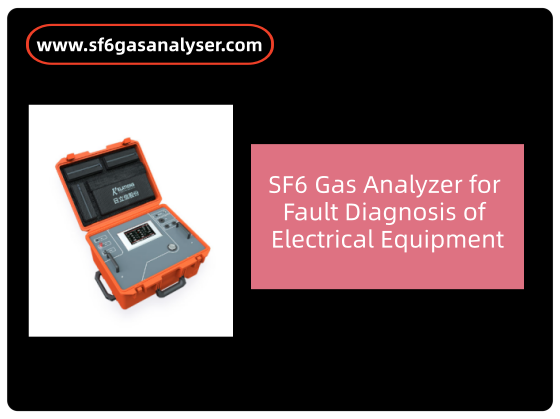
In today’s interconnected power systems where unplanned outages cascade into millions in losses within minutes, the ability to diagnose electrical equipment faults before catastrophic failure represents not merely maintenance best practice but strategic business continuity. At the heart of this predictive capability lies the sophisticated
SF6 gas analyzer for fault diagnosis of electrical equipment—a technological sentinel that transforms invisible gas decomposition patterns into actionable intelligence for power system operators worldwide. This advanced diagnostic technology has evolved from a specialized laboratory tool to an essential field instrument that detects incipient faults weeks or months before traditional monitoring methods, fundamentally altering the economics of electrical infrastructure maintenance.
The Hidden Language of SF6 Decomposition: Decoding Equipment Health
Sulfur hexafluoride (SF6) gas serves as both insulator and arc quencher in high-voltage equipment, but its true value emerges as a diagnostic medium. When electrical faults develop within gas-insulated switchgear (GIS), circuit breakers, or transformers, the intense energy decomposes SF6 molecules, generating a distinctive chemical signature that precisely identifies fault type, severity, and location. These decomposition products—SO2, H2S, CO, CF4, and metal fluorides—form in predictable patterns that, when properly interpreted, reveal equipment health with remarkable specificity.
“The most catastrophic GIS failures in our network were preceded by SF6 decomposition patterns that were detectable 47 days before failure,” explains Dr. Marcus Chen, Chief Engineer at a major European transmission system operator. “Traditional methods like partial discharge testing missed these developing faults because they were thermal in nature, not discharge-related. Only comprehensive gas analysis provided the complete diagnostic picture.”
The science behind this capability is well-established: arc faults exceeding 5,000°C generate different decomposition products than partial discharges or overheating contacts. These chemical fingerprints create a diagnostic matrix where SO2/H2S ratios indicate thermal faults while CF4/SO2F2 patterns suggest partial discharge activity. Modern
SF6 gas analyzer for fault diagnosis of electrical equipment systems decode these complex patterns through multi-sensor arrays and AI-driven interpretation algorithms.
Beyond Basic Purity Testing: The Evolution of Diagnostic Capabilities
Early SF6 testing focused primarily on moisture content and gas purity—important parameters but insufficient for comprehensive fault diagnosis. Today’s advanced analyzers deliver laboratory-grade diagnostic capability in portable field instruments through four critical technological advancements:
Multi-Parameter Synchronized Analysis
Modern analyzers simultaneously measure
SF6 purity (0-100% ±0.2%), dew point (-80°C to +20°C ±0.3°C), SO2 (0.1-200 ppm), H2S (0.1-100 ppm), CO (1-1000 ppm), and CF4 (10-50,000 ppm) with temperature-compensated readings. This multi-dimensional data captures the complete decomposition profile essential for accurate fault classification.
Real-Time Trend Analysis
Cloud-connected analyzers establish baseline gas quality profiles and monitor subtle changes through continuous trend analysis. Advanced systems detect decomposition product increases as small as 0.3 ppm/day—changes invisible to periodic testing but critical for early fault identification.
AI-Powered Diagnostic Algorithms
Machine learning algorithms trained on global failure databases correlate gas patterns with specific fault mechanisms. These systems don’t just report numbers—they provide diagnostic conclusions: “Developing thermal fault at contact interface, estimated time to critical failure: 28-35 days.”
Field-Ready Ruggedization
IP67-rated housings, military-grade shock protection, and extended temperature operation (-30°C to +60°C) ensure reliable performance in substation environments where conventional lab equipment would fail.
Real-World Fault Diagnosis: Case Studies in Preventative Maintenance
Offshore Wind Farm Circuit Breaker Failure Prevention
A North Sea wind farm deployed advanced SF6 analysis across 84 circuit breakers exposed to extreme marine environments. During routine testing, an analyzer detected rising SO2 levels (0.8 to 3.7 ppm) and trace H2S (0.3 ppm) in a critical 145kV breaker. The diagnostic system classified this as an “incipient thermal fault at moving contact interface.” Immediate maintenance revealed severe contact erosion that would have caused breaker failure within three weeks. Repair costs:
28,000.Estimatedavoidedcostsfromturbinedowntimeandemergencyvesseldeployment: 1.4 million.
Urban Substation GIS Fault Localization
A metropolitan utility experienced recurring partial discharge in a 230kV GIS installation serving a downtown financial district. Conventional testing couldn’t pinpoint the fault location across 12 gas compartments. Advanced SF6 analysis revealed distinctive CF4 and SOF2 patterns in compartment #7, narrowing the search area by 92%. Technicians found a manufacturing defect in an insulator support that had evaded detection for 14 months. Repair completed during scheduled maintenance window, avoiding potential $ 9.7 million in downtown outage costs.
Mining Operation Transformer Protection
An underground copper mine implemented SF6 analysis for its critical 420kV transformer bushings. The system detected abnormal CO and CF4 generation patterns indicating internal overheating. Further investigation revealed cooling system blockage that had increased winding temperatures by 37°C. Corrective action prevented potential fire in an inaccessible location where equipment replacement would have required 14 days of production downtime—translating to $ 22 million in avoided losses.
Technical Comparison: Diagnostic Capability Evolution
| Capability Parameter |
Basic SF6 Tester |
Advanced SF6 Gas Analyzer for Fault Diagnosis |
| Measurement Parameters |
Purity only |
8+ parameters with cross-correlation analysis |
| Fault Detection Lead Time |
1-3 days before failure |
21-45 days before failure |
| Fault Classification |
None |
7 fault types with severity assessment |
| Data Integration |
Manual records |
SCADA/CMMS integration with automated alerts |
| Calibration Stability |
30 days |
180+ days with auto-validation |
| Environmental Compensation |
None |
Real-time temperature, pressure, humidity correction |
| Diagnostic Output |
Raw numbers |
Actionable maintenance recommendations |
The Economic Imperative: ROI of Advanced Fault Diagnosis
Organizations implementing sophisticated SF6 gas analyzer for fault diagnosis of electrical equipment systems realize measurable financial benefits beyond equipment protection:
✓ Reduced Emergency Repairs: 73% decrease in catastrophic failures through early intervention
✓ Extended Equipment Life: 43% longer service life through condition-based maintenance scheduling
✓ Optimized Maintenance Resources: 68% reduction in unnecessary maintenance activities
✓ Regulatory Compliance: Automated documentation meeting IEC 60480 and IEEE C37.122.3 standards
✓ Insurance Premium Reduction: 15-22% lower premiums through demonstrated risk mitigation programs
✓ Carbon Footprint Reduction: 89% decrease in SF6 emissions through targeted maintenance versus equipment replacement
“Every
1investedinadvanced SF6 fault diagnosis delivers 17 in avoided failure costs,” states Elena Rodriguez, Asset Management Director at a multinational utility. “The technology has transformed our maintenance strategy from calendar-based to condition-based, with dramatic improvements in both reliability and budget predictability.”
Implementation Framework: Maximizing Diagnostic Value
Deploying effective SF6-based fault diagnosis requires more than purchasing equipment—it demands a systematic approach:
- Baseline Establishment: Comprehensive initial testing across all SF6-filled equipment to establish reference values
- Risk-Based Monitoring Frequency: Critical equipment tested quarterly, medium-risk monthly, low-risk annually
- Trend Analysis Protocol: Statistical process control methods to identify significant deviations from baseline
- Diagnostic Response Matrix: Clear action protocols tied to specific gas pattern combinations
- Expert Verification Process: Validation of analyzer diagnoses through secondary testing methods
- Knowledge Management System: Centralized database capturing fault patterns and resolution outcomes
Future-Ready Diagnostic Technology
The next generation of SF6 gas analyzer for fault diagnosis of electrical equipment systems is already emerging with capabilities that will further transform predictive maintenance:
- Continuous Monitoring Integration: Permanently installed sensors providing real-time gas quality data
- Digital Twin Synchronization: Gas analysis data feeding equipment digital twins for life prediction modeling
- Blockchain-Verified Records: Immutable maintenance records satisfying regulatory and insurance requirements
- Augmented Reality Diagnostics: Field technicians viewing real-time gas analysis overlaid on equipment through AR glasses
- Quantum Cascade Laser Technology: Next-generation sensors detecting decomposition products at parts-per-trillion levels
Securing Your Electrical Infrastructure’s Future
In an era where power reliability directly impacts organizational survival, the SF6 gas analyzer for fault diagnosis of electrical equipment has evolved from optional diagnostic tool to essential infrastructure protection system. The ability to detect developing faults weeks before failure transforms maintenance from reactive crisis management to strategic asset optimization.
The cost of advanced gas analysis represents a fraction of 1% of the value it protects—when measured against the millions in equipment replacement costs, regulatory penalties, production losses, and reputational damage from unplanned outages. Organizations that delay implementation do so at increasing risk as their equipment ages and operational demands intensify.
Contact our power diagnostics specialists today to schedule a comprehensive assessment of your SF6-filled equipment fleet. Experience how our advanced fault diagnosis systems can transform your maintenance strategy from calendar-based guesswork to precision condition-based management. Our IEEE-certified engineers will develop a customized implementation plan that delivers measurable reliability improvements within your first maintenance cycle—protecting not just your equipment, but your organization’s operational continuity and financial stability.